
- Cat BMI & Fitness Calculator
Cat BMI & Fitness Calculator
Is your cat truly fit, or are they secretly carrying dangerous fat reserves under their fur? Traditional weight scales can easily misjudge unique feline body frames. Use our scientific Feline Body Mass Index (FBMI) calculator to accurately map out your pet’s body fat percentage and unlock custom vet-approved dietary advice instantly.
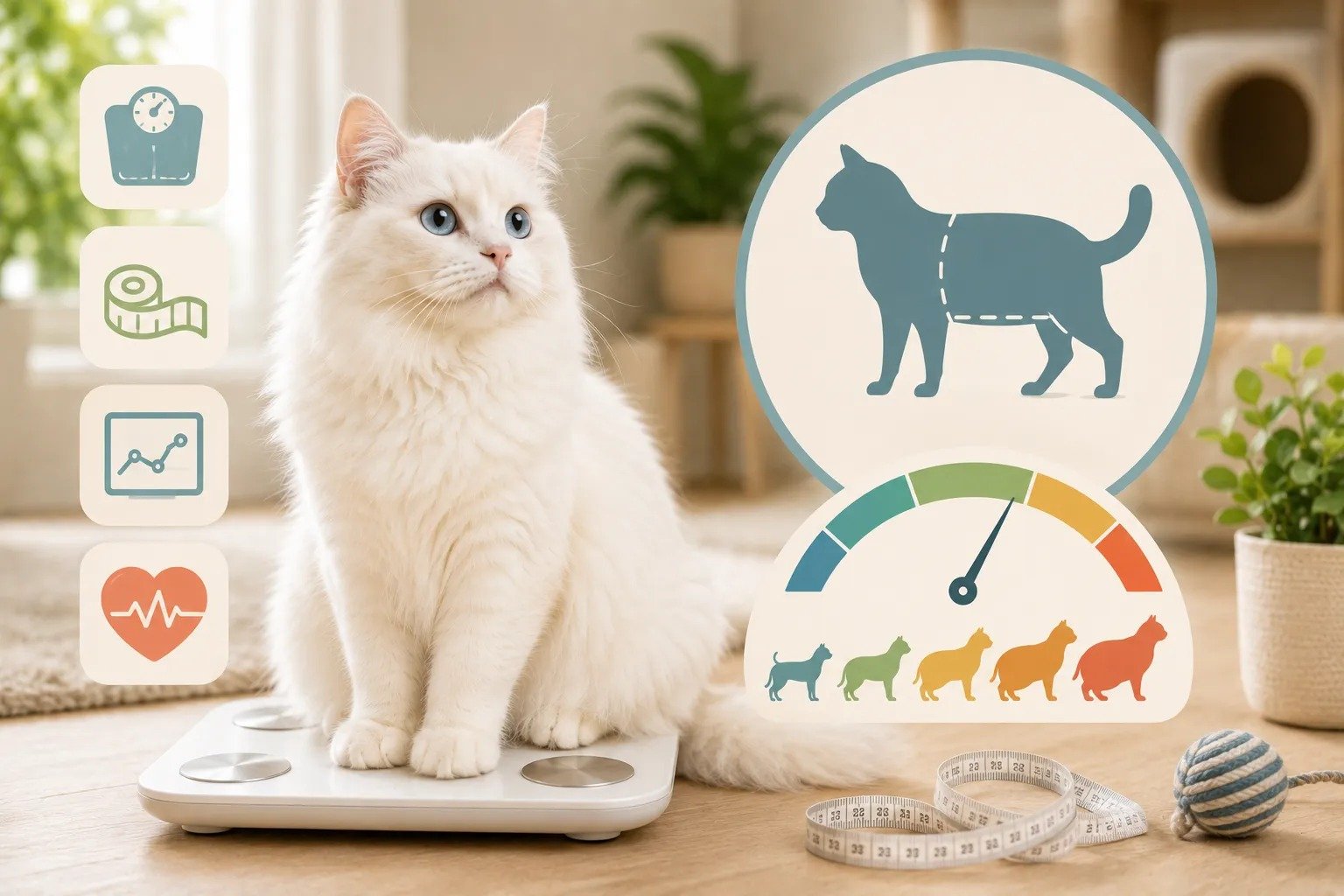
Feline BMI (FBMI) Calculator
Assess your cat's exact fat levels using scientific sizing metrics.
📋 Fitness & Dietary Blueprint
Loading assessment data...
Cat BMI Calculator: The Ultimate Guide to Cat Weight Management
As loving pet parents, we strive to keep our domestic companions happy, playful, and structurally vibrant. However, pet obesity has quietly emerged as one of the most widespread health crises facing domestic cats today. Carrying extra weight might make an indoor cat look soft and cuddly, but biologically, even a few surplus ounces put an immense metabolic strain on their compact bodies.
Many pet parents rely entirely on standard floor scales to judge whether their pet is healthy. Unfortunately, absolute body weight can be highly misleading. A large-framed Maine Coon will naturally weigh twice as much as a compact Siamese, even when both feature pristine body fat percentages.
To bypass these framing mistakes, veterinary researchers engineered the Feline Body Mass Index (FBMI), also referred to as the Feline Adiposity Index. Our advanced Cat BMI Calculator leverages these identical peer-reviewed calculations to track your pet’s body condition with pinpoint accuracy.
Why Standard Human BMI Principles Fail for Cats
When humans track body health via BMI, the equation is incredibly straightforward, matching raw body weight against vertical height. However, attempting to track a feline’s health using a basic height-to-weight ratio is functionally impossible.
Cats display massive skeletal diversity across unique breeds, and their horizontal spines make standard vertical height measurements highly subjective. Furthermore, a large percentage of an overweight cat’s fat reserves accumulate along the primordial pouch (the soft, loose belly skin flap designed to protect internal organs during fights) and across the lower rib cage.
Because fat drops down and spreads wide across their center of mass, checking a cat’s exact rib cage circumference paired with the structural length of their lower hind leg provides a mathematically superior reflection of actual tissue density.
The Core Advantages of Using Our Feline BMI Tool
Integrating consistent FBMI trackings into your monthly care checklist delivers profound health advantages:
- Eliminates Breed Bias: By assessing bone length against rib mass instead of relying on a flat scale value, the tracking system remains highly accurate whether your cat is a petite mixed-breed or a heavy domestic shorthair.
- Identifies Early Fat Accumulation: Long-haired felines (such as Persians or Ragdolls) can easily hide creeping weight gains underneath thick layers of dense fur. This scientific calculator cuts through visual masking by focusing on firm physical measurements.
- Clean, Practical Layout: The text architecture features clean line-height parameters, structured headings, and quick-scan informative tables for a modern reading experience.
Because of this physiological limitation, a cat’s liver processes chemical substances much more slowly. A dosage that feels tiny to a human can easily overwhelm a cat’s internal filtration organs. This is why our tool requires an exact weight input in either pounds (lbs) or kilograms (kg) before displaying any output.
An indoor cat weighing $10\text{ lbs}$ requires exactly $10\text{ mg}$ of active medication. If a well-meaning owner accidentally gives them a full adult $25\text{ mg}$ tablet, they are administering 2.5 times the safe clinical dose, pushing the animal directly into the danger zone for accidental overdose and severe central nervous system stimulation.
How to Measure Your Cat for Accurate BMI Tracking
Getting accurate inputs from an energetic or uncooperative cat requires gentle patience and proper technique. Follow this specific clinical measurement protocol to ensure your input data is highly accurate:
Step 1 — Use a Soft Measuring Tape: Never use a stiff, metal construction tape measure, as it will startle the animal and warp around curves. Grab a soft, flexible fabric tailor’s tape measure instead.
Step 2 — Measure the Rib Cage Circumference: Wrap the tape smoothly around your cat’s chest area right behind their front legs (typically over the 9th rib space). The tape should rest flush against the fur coat without compressing the underlying skin tissue.
Step 3 — Track the Lower Hind Leg Length: Locate the hind leg. Measure the distance from the midpoint of the patella (the knee joint) down to the tip of the calcaneus (the hock or heel bone joint). This provides the rigid skeletal baseline.
Step 4 — Input and Calculate: Select your preferred measurement units (inches or centimeters), input both dimensions into the calculator, and press the orange button to view your cat’s health tier instantly.
The Scientific Mathematical Formula Behind FBMI
The internal software script running behind our graphical interface relies on an intricate tiered equation developed during comprehensive veterinary clinical trials. The standard formula uses centimeter inputs to balance out tissue volumes:
FBMI = (((Rib Circumference ÷ 0.7062) − Leg Length) ÷ 0.9156) − Leg Length
A Real-World Calculation Walkthrough
Let’s track the math using a standard domestic adult cat displaying the following physical dimensions:
- Rib Cage Circumference: 36.0 cm
- Lower Leg Length: 12.0 cm
Comprehensive Feline BMI Status Matrix
To help you visualize where your pet stands across the metabolic tracking scale, review this comprehensive status reference chart:
| FBMI Score | Classification | Visual Characteristics | Action Required |
|---|---|---|---|
| Below 15.0 | Underweight | Ribs and spine easily visible; minimal muscle tone; obvious abdominal tuck. | Increase calorie density; test for underlying metabolic issues. |
| 15.0 – 29.9 | Ideal / Normal Weight | Ribs palpable with a slight fat cover; clear waistline visible from above. | Maintain current portion sizes; prioritize active play. |
| 30.0 – 42.0 | Overweight | Ribs difficult to feel under a thick fat layer; rounded belly; no visible waistline. | Restrict high-calorie treats; implement controlled feeding schedules. |
| Above 42.0 | Clinically Obese | Heavy fat deposits over back and face; prominent swinging abdominal pouch. | Urgent veterinary intervention; structured fat-reduction program. |
Top Health Risks Associated with High Feline Body Fat
Allowing a cat to remain in the overweight or obese ranges for years introduces serious systemic medical complications that can significantly shorten their life:
1. Feline Type 2 Diabetes Mellitus
Just like in humans, excess adipose tissue (fat cells) produces hormones that cause chronic systemic inflammation. This constant stress causes cellular receptors to become increasingly resistant to insulin. Because their bodies can no longer process blood sugars efficiently, the pancreas burns out, forcing the pet into a lifetime of daily insulin injections.
2. Accelerated Osteoarthritis
A cat’s skeleton is a marvel of evolutionary engineering, designed for vertical leaping and fluid agility. Carrying even one extra pound forces their delicate elbow, hip, and knee joints to bear constant, excessive loads. Over time, this wears down joint cartilage, resulting in severe chronic pain and limited mobility.
3. Hepatic Lipidosis (Fatty Liver Disease)
If an obese cat suddenly stops eating for even a couple of days due to stress, a minor illness, or a sudden change in diet, their body panics and floods the liver with stored fat cells to break down for fast energy. Unfortunately, a cat’s liver is not built to process large amounts of fat all at once. The organ quickly becomes overwhelmed and clogged with fat, causing acute liver failure — a life-threatening medical emergency.
6 Highly Detailed Frequently Asked Questions (FAQs)
Can I use a standard human BMI calculator to track my cat's health status?
My cat has a very large, hanging saggy belly pouch. Does that automatically mean they are obese?
How often should I measure my cat's chest and leg dimensions?
What is the safest way to help an overweight or obese cat lose weight?
Weight loss in felines must be approached slowly and carefully — dropping weight too fast can trigger hepatic lipidosis (fatty liver disease), which can be fatal. Eliminate free-feeding entirely, transition to structured measured meals, and swap high-calorie treats for interactive playtime like laser pointers or feather wands. Always consult your vet to set a safe target caloric intake before changing their diet.
Why does the calculator measure the lower hind leg bone length?
Can a cat's age or spay/neuter status impact their overall BMI readings?
Related Tools
Smart Pet Tools
Dog Age Calculator
Find your cat's age in human years
Pet Calorie Calculator
Create healthy meal plans for pets
Feeding Planner
Create healthy meal plans for pets
Vaccination Tracker
Track & never miss vaccination dates