
- 🍖 PET NUTRITION TOOLS
Cat Calorie Calculator
Har billi unique hoti hai, isliye unka khana bhi unki body ke mutabiq hona chahiye. Apni cat ka weight aur activity level enter karein aur janiye unki daily calorie requirement bilkul aasan lafzon me.
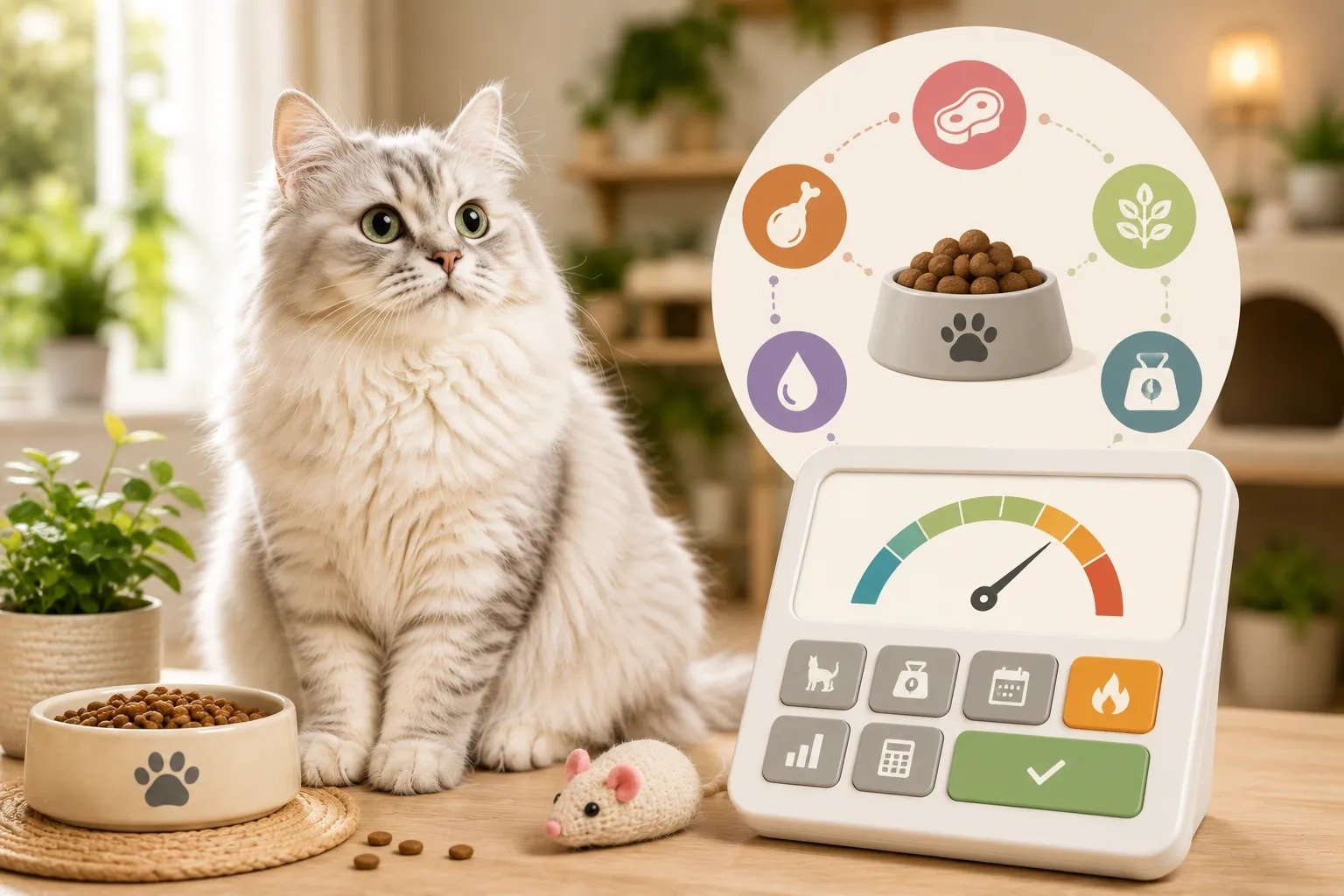
Cat Calorie Calculator
Find out exactly how much food your cat needs every day.
Cat Calorie Guide: How Much Should You Feed Your Cat?
As a devoted pet parent, your primary goal is to ensure your feline companion lives a long, vibrant, and joyful life. We all love seeing our cats zoom across the living room, pounce on their favorite toys, and curl up contentedly in our laps. However, when it comes to daily feeding routines, even the most well-intentioned cat owners frequently make mistakes.
It is easy to fall into the trap of overfeeding out of affection, which quickly leads to a prominent, saggy belly and sluggish behavior. On the flip side, underfeeding out of fear of obesity can leave your cat nutrient-deficient, weak, and lacking muscle mass.
Every single cat is a unique individual with distinct biological demands. A lazy, indoor adult cat who spends eighteen hours a day napping in sunbeams requires very little daily energy. In stark contrast, a tiny, high-energy kitten who is constantly sprinting, climbing curtains, and growing skeletal tissue requires a massive amount of fuel. Our Cat Calorie Calculator cuts through the guesswork, telling you exactly how many calories your cat needs to consume every day to thrive.
The short answer is yes, Benadryl can be used safely for cats—but only under strict veterinary supervision and with precise dosage calculations. Unlike humans, a small dosing error in a cat can quickly lead to severe toxicity due to their compact body mass and unique metabolic pathways.
Our professional Cat Benadryl Dosage Calculator is engineered to take the dangerous guesswork out of the equation. By calculating dosages based on the standard biological formula ($1\text{ mg}$ of medication per $1\text{ lb}$ of body weight), this tool provides an instant, accurate breakdown for both children’s liquid formulas and adult tablets.
In this comprehensive guide, we will break down the science behind Diphenhydramine for cats, analyze the exact math behind safe adjustments, guide you through stress-free administration techniques, and explore critical warning signs every responsible pet owner must know.
Why Calculating Your Cat's Calories Is Absolutely Essential
Many pet owners simply glance at the generic feeding chart printed on the back of a commercial dry food bag or wet food can and follow it blindly. However, those charts are merely broad baseline averages calculated for an “average” cat. They do not take into account your specific cat’s altered metabolism, lifestyle, or body frame.
If you feed every cat the exact same amount based purely on weight, you risk severely impacting their metabolic health. Here is why tracking specific daily calorie numbers matters:
1. Precision Weight Management
Feline obesity is a silent epidemic. When a cat carries even one or two extra pounds, it places immense structural strain on their compact skeletal system. This pressure makes basic movements like walking, jumping onto a couch, or climbing stairs highly uncomfortable or painful. By knowing their exact caloric threshold, you can prevent insidious weight gain or safely manage a structured weight-loss program without starving your pet.
If you feed every cat the exact same amount based purely on weight, you risk severely impacting their metabolic health. Here is why tracking specific daily calorie numbers matters:
2. Sustained, All-Day Energy Levels
Food is the literal fuel that powers your cat’s biological functions. Providing the perfect balance of daily calories ensures your feline companion stays energetic, mentally sharp, and playful throughout the day. When their caloric intake perfectly aligns with their output, you will notice a stark drop in chronic lethargy and a beautiful improvement in their mood and alertness.
If you feed every cat the exact same amount based purely on weight, you risk severely impacting their metabolic health. Here is why tracking specific daily calorie numbers matters:
3. Financial Savings & Zero Food Waste
Cat food—especially premium, human-grade wet food or specialized veterinary diets—is a significant ongoing investment. When you free-feed or scoop out random, unmeasured portions, you inevitably end up wasting expensive food that sits in the bowl and spoils. Knowing your cat’s explicit daily energy requirement allows you to purchase exactly what they need, saving money at the pet store while keeping their meals perfectly fresh.
If you feed every cat the exact same amount based purely on weight, you risk severely impacting their metabolic health. Here is why tracking specific daily calorie numbers matters:
How to Determine Your Cat's Daily Calorie Needs: 3 Easy Steps
Tracking down your cat’s exact nutritional sweet spot does not require a degree in veterinary science. You only need to follow three simple, stress-free steps, and our advanced tool will handle the complex algebraic formulas for you:
- Step 1 — Check Your Cat’s Weight: Gently weigh your cat to establish an accurate physical baseline. If you do not have a pet scale, you can weigh yourself on a standard bathroom scale while holding your cat, then subtract your own weight. Our tool seamlessly processes both kilograms (kg) and pounds (lbs) to keep things convenient for you.
- Step 2 — Identify Their Activity Level & Lifestyle: Take an honest look at your cat’s daily routine, age, and reproductive status. Is your cat highly active, or do they prefer a sedentary indoor lifestyle? Have they undergone spay or neuter surgery, which naturally slows down their resting metabolic rate? Are they currently on a vet-supervised fat-reduction plan, or are they a growing kitten?
- Step 3 — Click Calculate and Review the Results: Input these two vital metrics into the respective fields of the calculator and click the orange “Calculate Daily Calories” button. The software will instantly process the mathematical formulas behind the scenes and display your cat’s target daily energy requirement in total kilocalories (kcal).
If you feed every cat the exact same amount based purely on weight, you risk severely impacting their metabolic health. Here is why tracking specific daily calorie numbers matters:
Understanding the Relationship Between Age, Lifestyle, and Energy
To understand why the calculator alters numbers so drastically based on your selections, we must look at how lifestyle variables dictate a cat's internal engine. The table below outlines how a cat's profile directly alters their daily nutritional needs:
| Cat Profile / Life Stage | Typical Activity Level | Calorie Level Requirement | Why This Specific Level Is Vital |
|---|---|---|---|
| Young Kitten (Under 4 Months) | Intensely Active / Chaotic | Extremely High | Their bodies are working overtime to develop vital organs, dense muscle fibers, and strong skeletal bone structures. |
| Neutered / Spayed Adult Cat | Moderate / Normal | Standard Baseline | Surgical altering changes their hormonal profile, which naturally reduces their resting metabolic burn rate by roughly 20% to 25%. |
| Lazy / Indoor Household Cat | Low Activity / Sedentary | Moderately Low | Because indoor environments limit raw hunting behaviors, these cats spend most of their time sleeping and require much less fuel. |
| Weight Loss Diet Plan | Restricted / Controlled | Lowest Target | When a cat is already clinically overweight, their calorie count must be carefully dialed back to force the body to safely burn stored fat. |
Deep-Dive Nutrition FAQs: Everything Pet Parents Need to Know
Can I mix dry kibble and wet canned food together in my cat's daily diet?
Yes, absolutely! In fact, mixing wet and dry food is highly recommended by veterinarians worldwide. Wet food features an incredibly high moisture content (often around 70% to 80% water), which is exceptional for maintaining proper hydration, flushing out your cat’s urinary tract, and reducing the risk of chronic kidney disease. Dry food, on the other hand, is highly energy-dense and convenient for foraging toys. The vital trick is to ensure that the combined calories of both the wet and dry portions do not exceed the total daily number provided by our calculator. For example, if your cat needs 200 kcal a day, you can feed them 100 kcal worth of canned food in the morning and 100 kcal worth of dry kibble in the evening.
Where can I find the calorie information on my commercial cat food packaging?
By law, pet food manufacturers must display calorie content on their packaging, though it is often tucked away in small print near the ingredient list or guaranteed analysis section. Look for a label labeled “Metabolizable Energy” (or ME). This metric is typically displayed as kcal per kilogram of food, or as kcal per standard measuring cup or per individual can. Once you know the exact kcal count of your specific food brand, you can easily divide your calculator’s daily result by that number to figure out the perfect scoop size or fractional can portion for each meal.
Why do cats need fewer calories immediately after being spayed or neutered?
Spaying or neutering is a fantastic, responsible medical procedure that prevents reproductive cancers and unwanted litters. However, removing a cat’s reproductive organs drastically alters their baseline endocrine (hormone) system. Without those reproductive hormones circulating, a cat’s resting metabolic rate automatically plummets by nearly a quarter. Additionally, altered cats frequently display a calmer temperament with less desire to roam or territory-mark, meaning they naturally burn fewer calories through movement. If you keep feeding them the exact same portion sizes after their recovery that they ate before the surgery, the extra unburned energy will quickly accumulate as visceral body fat. Always select the “Neutered Adult” option to keep their weight perfectly stable.
What should I do if my cat is constantly begging for food even though I am feeding them their exact calculated calories?
How quickly should an overweight cat lose weight on a restricted diet plan?
When helping an overweight or obese cat lean down, speed can be incredibly dangerous. You must never drastically slash your cat’s food intake overnight in an attempt to get fast results. If a heavy cat experiences a sudden, extreme drop in calories or stops eating altogether, their body enters a state of panic and rapidly mobilizes stored fat reserves, sending them straight to the liver to be broken down for emergency energy. Because a feline liver is not biochemically equipped to process huge influxes of fat at once, the organ quickly becomes overwhelmed, triggering a severe, life-threatening condition known as Hepatic Lipidosis (Fatty Liver Disease). A safe, clinically sound weight loss rate for a cat is a gradual 0.5% to 2% of their total body weight per week.