

Your cat’s asleep on the couch, and you’re wiping your nose for the third time tonight, half-hoping an allergy pill fixes everything and half-dreading it won’t. Maybe you’ve already searched this at 2 a.m., itchy-eyed and Googling instead of sleeping. You don’t need another list of symptoms you already know you have. You need a straight answer: how bad is this, what will it cost to fix, and can you actually keep her? That’s what this guide gives you, plainly and without the guilt trip.
What Do Cat Allergies Actually Mean for You?
Cat allergies are an immune system overreaction to proteins in a cat’s saliva, skin oil glands, and urine, affecting 10% to 25% of the U.S. population. Your body mistakes these harmless proteins for a threat and releases histamine to fight them off, which is what triggers the sneezing, itching, and congestion you actually feel.
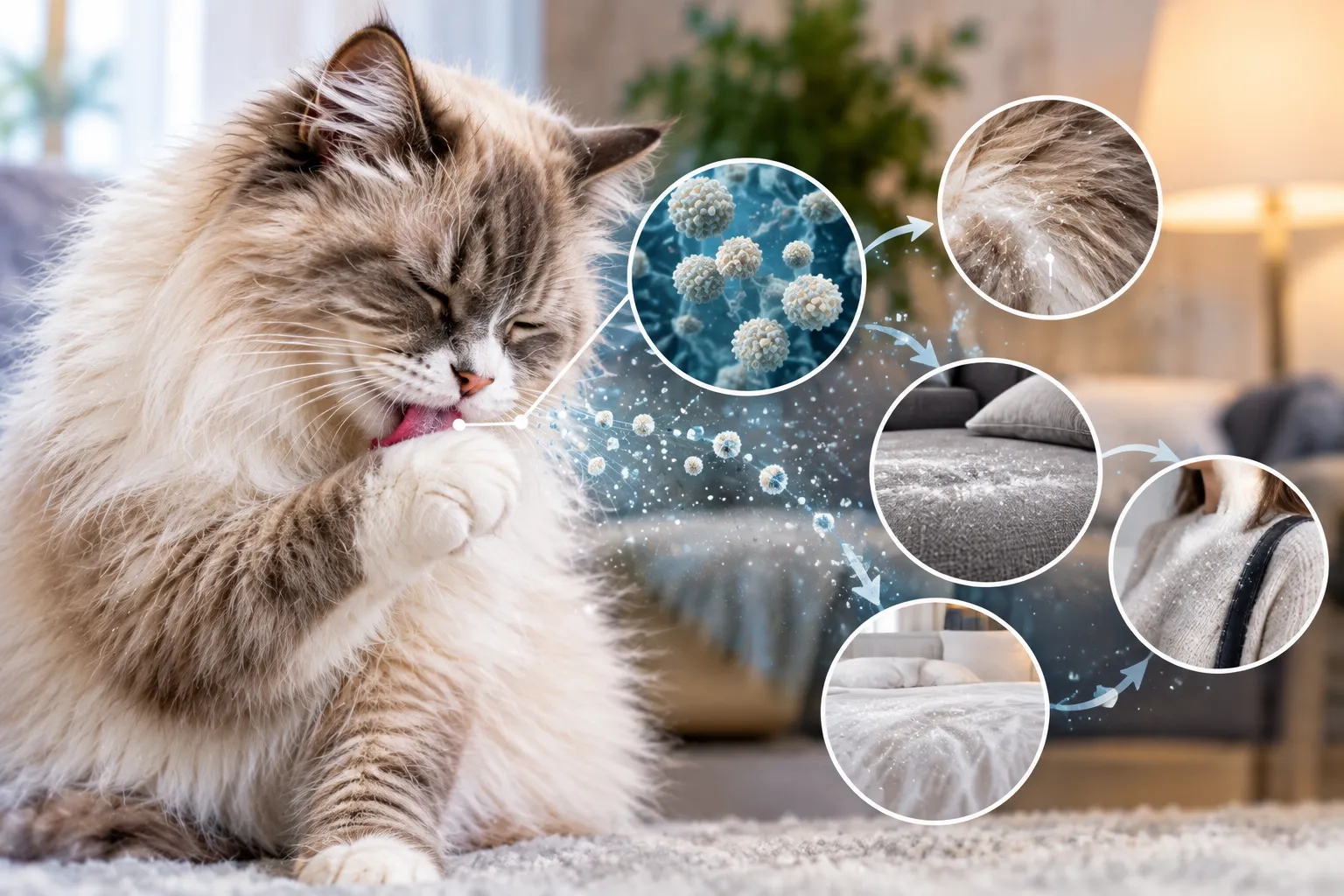
This reaction happens in stages. A cat grooms itself, spreading saliva and skin oil across its fur; that fur dries and sheds microscopic allergen particles into the air and onto every surface in your home. You inhale those particles or touch a surface carrying them, your immune system flags the protein as dangerous, and within minutes to hours your eyes water, your nose runs, or your skin reacts. The severity of that reaction, and how urgently you need to act on it, depends entirely on how sensitized your immune system has become to the protein.
What Do Cat Allergies Actually Mean for You?
Cat allergies affect 10% to 25% of the U.S. population, making them one of the most common indoor allergy triggers people search for answers about. Behind nearly every search sits the same unspoken question: can I keep my cat?
Most articles answer with generic symptom lists or a vague recommendation to see a doctor. Neither approach tells you how severe your reaction is, what treatment will cost, or whether your specific situation allows you to keep your pet. Someone with occasional sneezing faces a completely different decision than someone whose asthma flares every time a cat walks into the room, and lumping both cases under one generic answer helps neither of them plan a realistic next step. This guide fills that gap with a severity framework matching your symptoms to specific actions, real cost numbers for testing and treatment, and a room-by-room plan combining medical management with practical home changes, so you get the information your allergist assumes you already have, instead of another generic checklist that stops at “see your doctor.”
What Causes Cat Allergies?
Cat allergies come from a protein called Fel d 1, found in cat saliva, skin oil glands, and urine, not from the fur itself. Fur simply carries the protein once it’s there.
Cats produce Fel d 1 in their sebaceous (skin oil), salivary, and anal glands. Saliva spread during grooming dries into microscopic dander flakes just 2 to 10 microns wide, small enough to stay airborne for hours. This is why cat allergens turn up in homes, schools, and offices that have never had a cat present; visitors carry the protein on clothing, bags, and shoes.
Fel d 1 accounts for 90% to 95% of allergic reactions in people sensitized to cats, according to Thermo Fisher’s ImmunoCAP research. Three minor proteins (Fel d 2, Fel d 4, and Fel d 7) cause reactions in fewer patients and sometimes overlap with dog or horse allergens, a pattern called cross-reactivity that changes how a doctor approaches diagnosis and treatment.
Concentration matters as much as source: the highest Fel d 1 levels sit on a cat’s face and neck, where oil glands cluster most densely, and grooming spreads the protein onto furniture, doorframes, bedding, and anything the cat rubs against, which is why allergen levels build up gradually across a household rather than staying confined to one spot.
How Do Doctors Diagnose Cat Allergies?
Doctors confirm cat allergies through a skin-prick test or a specific IgE (immunoglobulin E) blood test, and neither replaces the value of your own symptom history.
During a skin-prick test, a doctor places small amounts of purified cat allergen extract on your forearm or upper back, then pricks the skin lightly underneath. A raised, itchy, red bump within 15 minutes indicates sensitization, though antihistamines and certain skin conditions can skew the result.
A blood test measures specific IgE antibodies your immune system produces in response to cat allergens. Component-resolved testing goes further, breaking results down by individual protein: Fel d 1, Fel d 2, Fel d 4, and Fel d 7, showing whether you react specifically to cats or to a cross-reactive protein also found in dogs or horses.
High Fel d 1 sensitivity marks a candidate for allergen immunotherapy, while cross-reactive results might point a doctor toward broader environmental allergy management instead. Testing accuracy isn’t perfect, since false positives and negatives happen, so doctors sometimes recommend a trial period away from cats, tracking whether symptoms improve as confirmation alongside formal test results.
Do Hypoallergenic Cats Really Exist?
No cat breed is truly hypoallergenic, because every cat produces Fel d 1 regardless of coat length, breed, or grooming habits. The myth persists because some breeds produce measurably less of the protein.
Siberian and Balinese cats have reputations for lower Fel d 1 production, and some allergy sufferers report milder reactions around these breeds, a real but modest difference, not an absence. A person with severe allergies will likely still react to a Siberian cat, just possibly less intensely than to a Persian or Maine Coon.
Sex and neuter status affect allergen production more consistently than breed does. Intact male cats produce significantly more Fel d 1 than neutered males or females, one practical reason, beyond population control, that veterinarians recommend neutering. Choosing a spayed female or neutered male over an intact male gives a measurable benefit to a household managing allergies.
Coat length has almost no bearing on allergen levels, despite popular belief. A hairless Sphynx cat still produces Fel d 1 in its skin oil and saliva; it simply has less fur to trap and redistribute the protein, easing cleanup without lowering the underlying allergen source.
How Severe Are Your Cat Allergies?
Cat allergy severity falls into four levels, mild, moderate, severe, and emergency, and matching your symptoms to the right level determines your next step.
Mild Severity
Mild cat allergy symptoms include occasional sneezing, watery eyes, and reactions that resolve within a few hours of leaving the environment. Start with over-the-counter antihistamines and basic home exposure reduction, since most people in this category manage symptoms comfortably without giving up their cat or pursuing extensive testing, and rarely need to escalate beyond simple, low-cost management.
Moderate Severity
Moderate symptoms show up as persistent congestion, skin reactions, and sleep disruption, with effects that last into the next day rather than fading quickly. Schedule an allergist appointment for formal testing, combine daily antihistamine use with the room-by-room reduction plan below, and reassess after 4 to 6 weeks to see whether that combination is enough or whether further treatment makes sense.
Severe Severity
Severe symptoms involve wheezing, chest tightness, frequent rescue inhaler use, and real breathing difficulty that goes beyond nasal discomfort. See an allergist immediately rather than waiting, discuss prescription-strength treatment, and evaluate whether immunotherapy makes sense; if asthma doesn’t improve within 2 to 4 weeks of aggressive management, keeping the cat in the home may not be medically advisable, particularly for children or anyone with pre-existing lung conditions.
Emergency Severity
Emergency symptoms include anaphylaxis, severe breathing distress, or loss of consciousness following cat exposure, and none of these situations call for home management of any kind. This is a call-911 scenario requiring immediate medical intervention, since the risk of delay outweighs any benefit of waiting to see whether symptoms pass on their own.
Moderate symptoms typically respond to consistent management within weeks, while severe symptoms often require professional intervention before home strategies work at all.
What Are the Symptoms of Cat Allergies?
Cat allergy symptoms range from occasional sneezing to asthma attacks requiring emergency treatment, and the category you fall into determines how urgently you need to act.
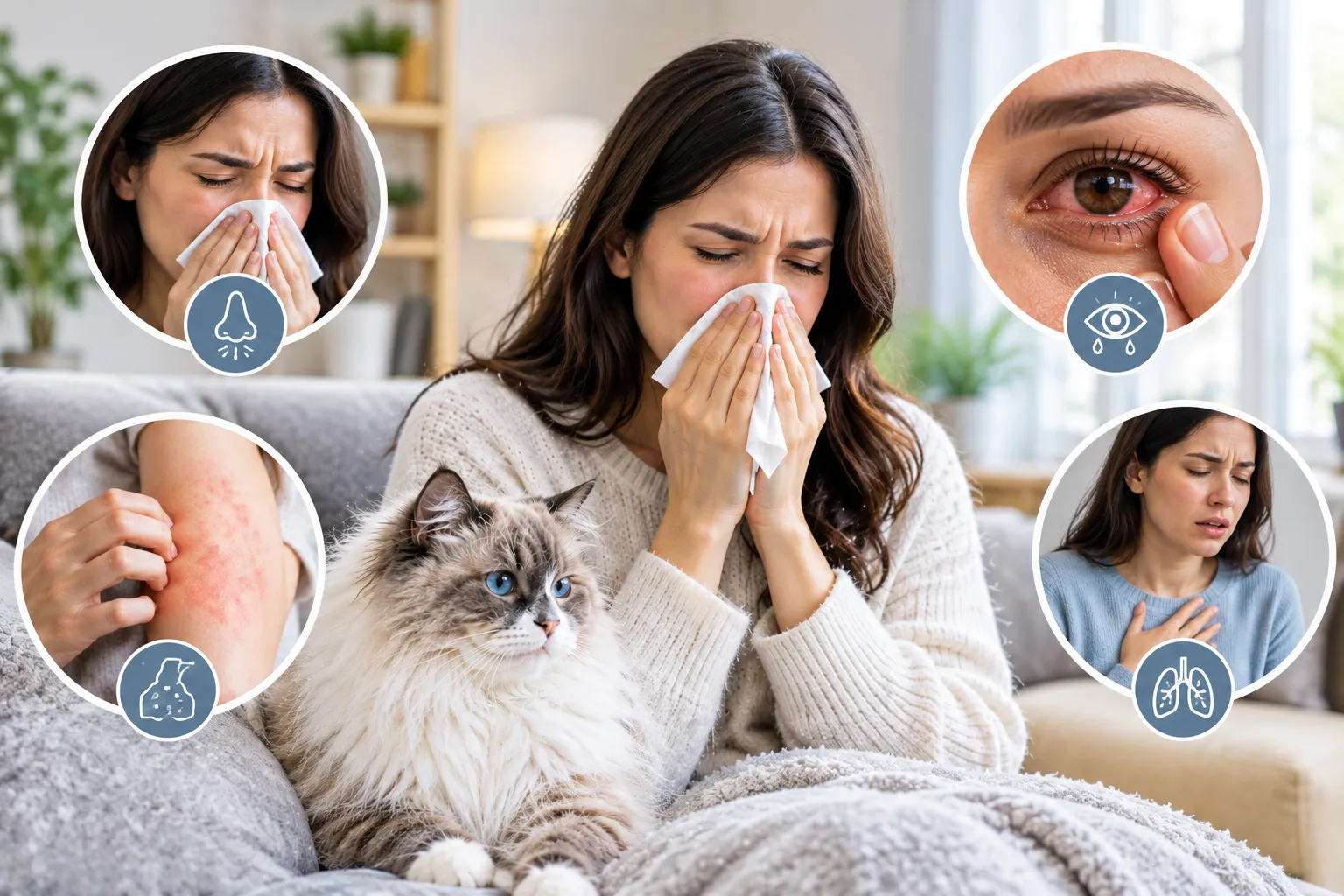
Mild symptoms (sneezing, a runny or stuffy nose, itchy or watery eyes) appear within 15 to 30 minutes of exposure and fade within hours once you leave the environment.
Moderate symptoms add hives or a rash where a cat has licked or scratched you, itchy skin, postnasal drip, facial pressure, and congestion lasting into the next day, often with sleep disruption from a stuffy nose waking you repeatedly.
Severe symptoms hit the lower airway: wheezing, chest tightness, coughing, and shortness of breath. Roughly 20% to 30% of people with allergic asthma have serious flare-ups after cat exposure, and needing a rescue inhaler more than twice a week signals it’s time for medical evaluation rather than home management alone.
Symptoms can also build slowly rather than appear immediately, peaking 8 to 12 hours after exposure, a delay that makes it easy to blame the wrong trigger when other allergens are present too.
Anaphylaxis from cat exposure is rare but possible, especially from a bite that introduces allergenic proteins directly into the bloodstream. Watch for pale, clammy skin, a weak rapid pulse, confusion, and difficulty breathing; call 911, keep the person lying down with legs elevated, and use epinephrine if it’s available and prescribed.
What Is the Best Cat Allergy Treatment, and What Does It Cost?
Cat allergy treatment costs range from under $50 a year for basic antihistamines to $3,000 or more over several years for full immunotherapy, depending on severity and the path you choose. The table below breaks down what each option actually costs.
| Treatment | Cost |
| Over-the-counter antihistamines (cetirizine, loratadine, fexofenadine) | $10-20/month ($120-240/year) |
| Prescription nasal steroids (fluticasone, budesonide) + antihistamine | $300-700/year |
| Standard allergy testing (skin-prick or IgE blood panel) | $200-500 |
| Component-resolved testing (Fel d 1, Fel d 2, Fel d 4, Fel d 7) | $300-600 |
| Immunotherapy: initial testing and serum | $300-600 |
| Immunotherapy: weekly shots, 6-month buildup phase | $50-150/shot ($1,500-3,000 year one) |
| Immunotherapy: maintenance phase | $600-1,200/year |
| HEPA (high-efficiency particulate air) purifier + filters | $150-400 + $30-80 every 6-12 months |
| 5-year total, antihistamine-only | $600-1,200 |
| 5-year total, antihistamine + steroid + home tools | $2,500-4,000 |
| 5-year total, full immunotherapy + home management | $4,000-7,000 |
Home management tools add a smaller, ongoing cost on top of whichever medical path you choose. The five-year totals above show why matching treatment to actual severity, rather than defaulting to the most aggressive option, matters for your budget as much as your symptoms.
How Long Does Cat Allergy Immunotherapy Take to Work?
Allergen immunotherapy takes 3 to 5 years to complete and produces meaningful symptom improvement in 60% to 80% of patients, though most guides only say it “takes years” without specifying what that means.
The buildup phase involves weekly injections with gradually increasing cat allergen extract, typically lasting 4 to 6 months, with some symptom reduction often noticeable by month 3 or 4.
Maintenance follows, with injections every 2 to 4 weeks for the remaining 3 to 5 years, which is where most of the real improvement accumulates, since the immune system needs sustained exposure to build lasting tolerance.
Success varies: some patients reach near-complete symptom resolution and tolerate cat exposure without medication; others see a 50% reduction and still need occasional antihistamines. Roughly 20% to 40% see minimal improvement and may need ongoing medication indefinitely.
Immunotherapy isn’t recommended before age 5, and adults with severe pre-existing asthma may need closer monitoring. For someone with severe, life-limiting reactions who wants to keep their cat, the multi-year commitment often makes sense; for mild symptoms, it usually isn’t worth the investment.
How Do You Reduce Cat Allergens at Home?
Combining behavioral changes, product-based cleaning, and strategic room restrictions reduces cat allergen exposure more effectively than any single approach alone.
Bedroom
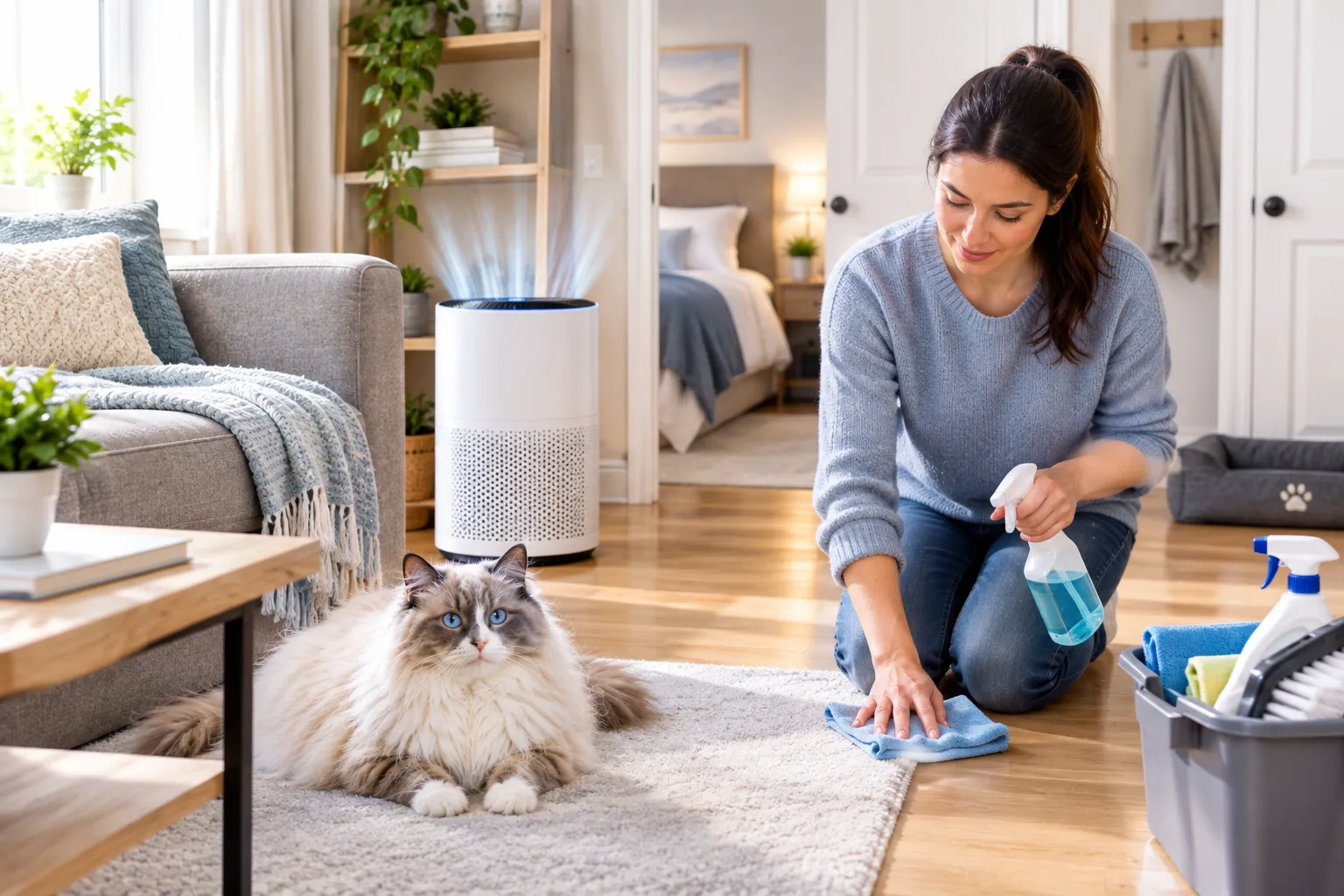
Keep your cat out of the bedroom entirely and keep the door closed, since airborne Fel d 1 runs far higher in rooms where a cat spends time, and you breathe that air for 6 to 9 hours every night without realizing it. Wash bedding weekly in hot water and run a HEPA air purifier continuously in this room, since concentrated overnight exposure often drives the worst morning symptoms for people managing cat allergies.
Living Areas
Carpet holds up to 13 times more cat allergen than smooth flooring, according to household allergen research from Ohio State University’s veterinary program. Replace wall-to-wall carpet with hardwood, tile, or laminate where possible, and if that isn’t realistic, vacuum twice weekly with a certified HEPA filter and steam-clean the remaining carpet regularly to break down buildup between sessions.
Furniture
Choose leather or tightly woven fabric over plush upholstery, which traps allergens far more readily than smoother materials do. Wash removable cushion covers and throw blankets weekly, and treat your cat’s favorite resting spot on the couch with an allergen-neutralizing spray between regular cleanings, since a single preferred spot often becomes the highest-concentration allergen zone in the room.
Air Handling
Add a HEPA filter to your central heating and cooling system if it supports one, and run a dedicated HEPA air purifier in whatever room your cat spends the most time. This combination cuts airborne allergen concentration by five to seven times compared to no filtration at all, making it one of the higher-impact changes on this entire list.
Grooming Routine
Bathe your cat weekly if she tolerates water, since this reduces surface allergen levels by up to 84%, though the effect is temporary and levels return close to baseline within 24 to 48 hours. For cats that resist bathing, allergen-reducing grooming wipes offer a lower-stress alternative used every 2 to 3 days instead.
Personal Habits
Wash your hands immediately after touching your cat, and avoid touching your eyes or face beforehand to limit direct transfer of allergen. Change clothes after extended contact if your symptoms are moderate to severe, and wear an N95 mask when vacuuming or handling litter, since both activities stir settled allergens back into the air.
How Are Cat Allergies Different in Children?
Children show the same symptom range as adults (sneezing, itchy eyes, skin reactions, and asthma flares) but face two additional risks: undiagnosed exposure at school or daycare, and a higher likelihood that allergies signal a broader atopic tendency.
A child who seems fine at home but reacts at a friend’s house or daycare may be picking up indirect cat exposure carried in on someone else’s clothing, an easy pattern to miss until it repeats. Pediatric allergists recommend testing when a child shows recurring respiratory symptoms, chronic ear infections, or eczema alongside suspected pet exposure, since early cat sensitization correlates with higher rates of asthma and other environmental allergies later on.
The severity framework above applies the same way for kids: start with exposure reduction and pediatric antihistamines, escalating to an allergist if symptoms don’t improve within 4 to 6 weeks, and seeking evaluation within days, not weeks, for severe or asthma-related symptoms. Rehoming a cat over a child’s allergy is one of the hardest calls parents face, and sometimes it’s the right one, since severe, poorly controlled asthma tied to cat exposure carries real health risk that outweighs sentimental attachment.
Can You Keep Your Cat If You’re Allergic?
Yes, most people with cat allergies can keep their cat, provided their symptoms fall in the mild-to-moderate range and they commit consistently to management strategies. The exceptions are severe, poorly controlled asthma and any history of anaphylactic reaction to cat exposure.
Run through this quick self-check: mild symptoms responding to occasional antihistamine use need no major lifestyle change beyond basic hygiene. Moderate symptoms call for the full room-by-room reduction plan, given 4 to 6 weeks to work. Severe symptoms that haven’t improved after aggressive management, including an immunotherapy consultation, may mean the health cost of keeping the cat outweighs the emotional cost of rehoming.
No management strategy, whether bathing, HEPA filtration, medication, or immunotherapy, completely eliminates cat allergens from a home. The realistic goal is reducing exposure and symptom severity to a livable level, not achieving zero reaction, and most people who commit to a layered approach reach that threshold within a few months.

FAQs
Do hypoallergenic cat breeds exist?
No. Every cat produces Fel d 1 protein regardless of breed. Siberian and Balinese cats produce measurably less, which may reduce symptom intensity, but won’t eliminate reactions for people with true cat allergies.
Can you develop cat allergies later in life?
Yes. Immune systems change over time, and new exposure patterns, such as a shedding-heavy cat, sleeping arrangements, or hormonal shifts, can trigger sensitization in adulthood even without childhood allergy history.
How long do cat allergy shots take to work?
Initial improvement often appears by month 3 or 4 of weekly buildup injections. Full treatment spans 3 to 5 years, with 60% to 80% of patients reporting meaningful symptom reduction by completion.
Does bathing a cat actually reduce allergens?
Yes, temporarily. Weekly bathing cuts surface allergen levels by up to 84%, but levels return to baseline within 24 to 48 hours, making consistency more important than any single bath.
Are male or female cats more likely to trigger allergies?
Intact male cats produce more Fel d 1 than females or neutered males. Choosing a spayed or neutered cat measurably lowers household allergen levels compared to an intact male.
Conclusion
Cat allergies rarely come down to a simple keep-or-rehome decision; they come down to matching your specific symptom severity to the right combination of testing, treatment, and home management. Mild symptoms respond to basic antihistamines and hygiene changes within days. Moderate symptoms need a structured room-by-room reduction plan given 4 to 6 weeks to show results. Severe symptoms require an allergist’s involvement before any home strategy can work reliably. The Fel d 1 protein driving nearly all cat allergy reactions can’t be eliminated from a household with a resident cat, but it can be reduced enough for most people to live comfortably alongside their pet.