
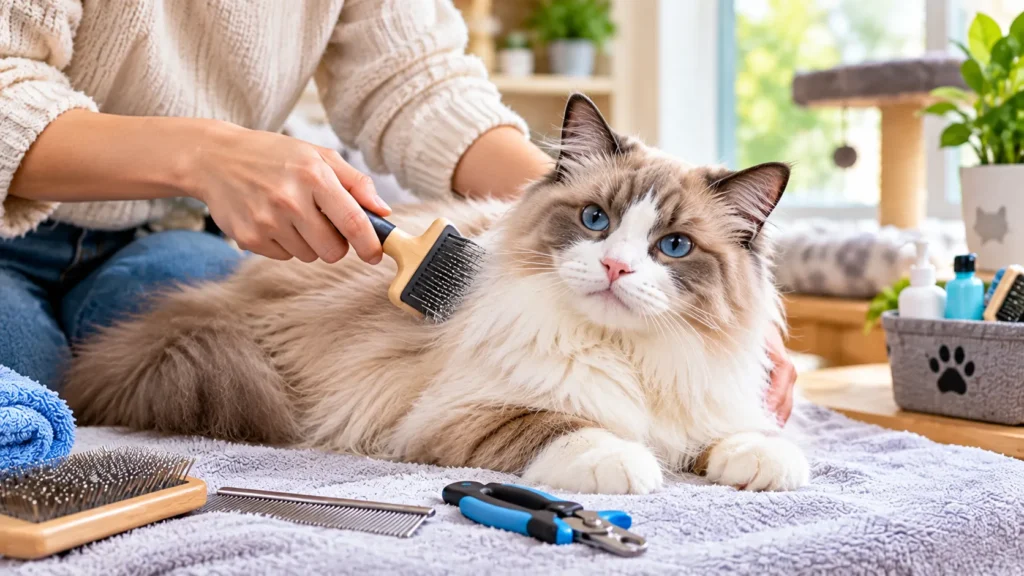
Cat grooming supports skin health, reduces hairballs, and catches medical problems early — even though cats spend up to 50% of their waking hours grooming themselves. A cat’s tongue removes surface debris but can’t trim nails, reach every mat forming behind the ears, or flag early signs of skin infection the way your hands will during a weekly check. Six distinct routines make up complete grooming: brushing, bathing, nail trimming, ear cleaning, dental care, and eye checks. Each runs on its own schedule, and skipping any one creates predictable problems three weeks without a nail trim means claws start catching on carpet, while skipped ear checks let a mite infestation go unnoticed for months.
This guide covers exactly how often to do each task, what grooming costs at home versus with a professional, and how routines should shift for kittens and senior cats. Scattered advice exists across veterinary fact sheets, product blogs, and grooming salon service lists; here, it’s consolidated in one place.
The Complete Cat Grooming Frequency Chart
Cat grooming frequency depends on the task: brushing needs weekly to daily attention, while nail trims, ear checks, and dental care run on longer 10-day to weekly cycles. No single schedule covers every task, which is why most existing guides leave owners guessing.
| Task | Short-Haired Cats | Long-Haired Cats | Notes |
| Brushing | 1-2 times weekly | Every 2-3 days, daily during shedding season | Long-haired cats mat faster without frequent attention |
| Bathing | As needed (sticky/dirty coat, skin condition) | As needed, more often for oily coats | Most cats never need a full bath |
| Nail trimming | Every 10-14 days | Every 10-14 days | Applies regardless of coat length |
| Ear checks | Weekly visual check | Weekly visual check | Clean only when wax or debris is visible |
| Dental care | 2-3 times weekly brushing (daily ideal) | 2-3 times weekly brushing (daily ideal) | Water additives and dental treats supplement, don’t replace, brushing |
| Eye checks | Before or during grooming sessions | Before or during grooming sessions | Daily for flat-faced breeds prone to tear staining |
Shedding season complicates the brushing schedule. Most cats shed heavily in spring and early summer, and indoor cats under artificial light can shed lightly year-round. During peak shedding, daily brushing for 5 minutes prevents far more hairballs than a single weekly 20-minute session — frequency matters more than duration here.
Brushing: Technique by Coat Type
Brush short-haired cats with a rubber brush or metal comb, working head to tail in the direction of hair growth, while long-haired cats need a wide-toothed comb starting from the legs and abdomen. The technique differs enough that using the wrong approach on the wrong coat type causes more tangles, not fewer.
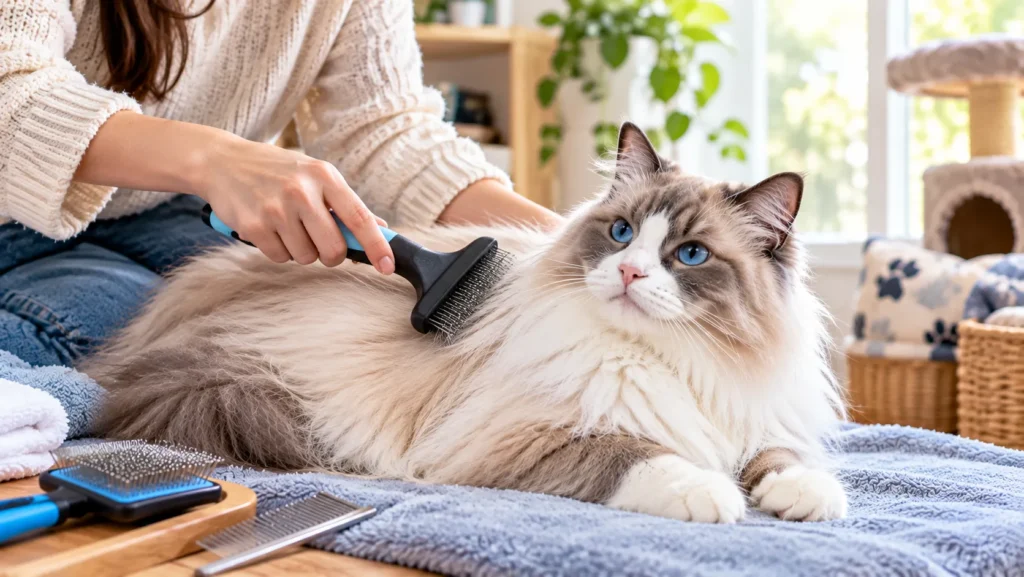
For short-haired cats, work in sections. Start at the head, move down the back, then cover the chest and abdomen last. A rubber brush lifts loose undercoat hair that a metal comb might skip over, particularly on cats with dense, close-lying fur like a Domestic Shorthair or British Shorthair.
Long-haired cats need a different starting point entirely. Begin with the legs and abdomen, since mats form fastest in these low-friction areas where fur rubs against furniture and floors. Comb the neck fur upward toward the chin, and part the tail down the middle to brush each side separately. Small mats respond to a light dusting of cornstarch or talcum powder worked in with your fingers before combing; larger mats need a mat-splitter tool rather than scissors, since scissors risk cutting skin hidden beneath dense fur.
Run your hands over your cat’s entire body during every brushing session, not just where the brush goes. This catches early signs most owners miss: a small lump near the shoulder, a scab hidden under the chin, or a bald patch starting at the base of the tail. One owner might notice a pea-sized lump during a Tuesday brushing session and get it checked before it grows large enough to see without touching that’s the practical value of combining brushing with a physical exam.
Bathing Your Cat: When and How
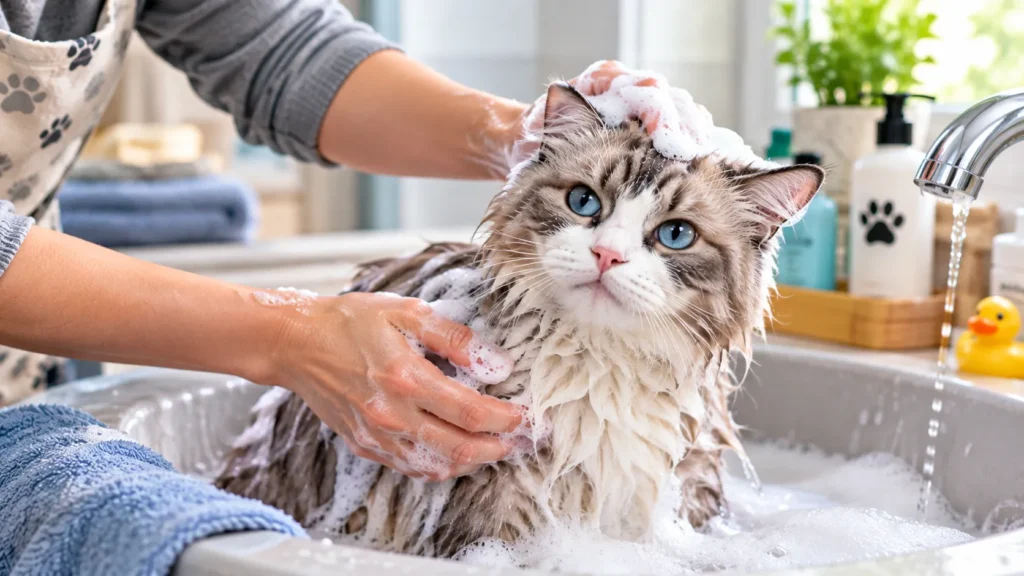
Bathe your cat only when she’s visibly dirty, has gotten into something sticky, or has a skin condition your vet recommends treating with medicated shampoo — not on a fixed weekly or monthly schedule. Most cats never need a full-body bath in their lives, since their own grooming plus regular brushing handles normal cleanliness.
Prepare the space before bringing your cat in. Fill a sink or tub with 3 to 4 inches (about 7.5 to 10 centimeters) of lukewarm water, place a rubber mat on the bottom to prevent slipping, and put cotton balls loosely in her ears to keep water out. Trim nails beforehand if possible; a startled cat with full claws does real damage to bare arms.
Dilute cat shampoo at a 1-to-5 ratio with water undiluted shampoo, even cat-specific formulas, can dry out sensitive skin. Work the solution from head to tail, avoiding the face entirely, and use a handheld spray hose or plastic pitcher to wet and rinse rather than submerging her head-first. Rinse until no residue remains; leftover shampoo attracts dirt and can irritate skin within days.
Waterless alternatives work well for cats with skin conditions or ones who resist water entirely. Foaming waterless shampoos and grooming wipes lift dirt and dander between full baths without the stress of running water, and they’re a reasonable full substitute for cats who tolerate wipes better than sinks. A cat recovering from a skin infection, for instance, might use medicated wipes daily while a full bath happens only during vet-directed treatment weeks.
Nail Trimming Without the Fight
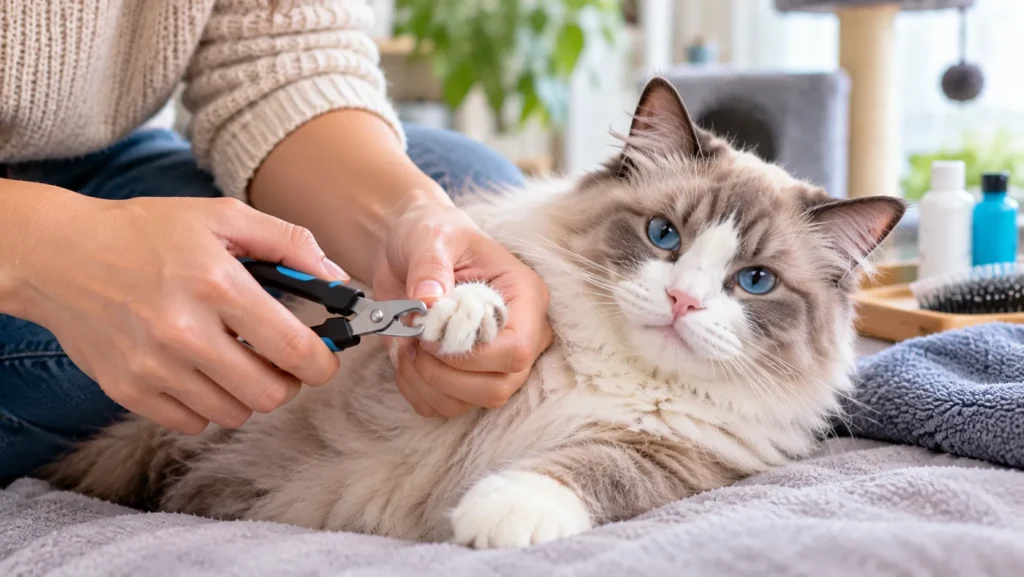
Trim cat nails every 10 to 14 days, cutting only the sharp white tip and avoiding the pink “quick” where nerves and blood vessels sit. This interval keeps nails short enough to prevent snagging on carpet and furniture without over-trimming into sensitive tissue.
Choose a calm moment right after a meal or during a sleepy, relaxed stretch works better than an active play session. Sit with your cat in your lap in a quiet room, away from windows where outdoor birds or movement might trigger a bolt reaction. Press gently on each toe pad to extend the claw, and snip only the sharp tip; if you accidentally cut into the quick, styptic powder stops the bleeding within a minute or two.
Desensitize a nervous cat gradually rather than forcing the full process at once. Hold the clippers near your cat without using them for several sessions first, letting her sniff them and associate the tool with treats rather than restraint. A well-known trick: trim a piece of dry, uncooked spaghetti with the clippers near your cat before attempting real nails — the snapping sound mimics a nail clip and helps her adjust to the noise without any actual pressure on her paws.
Limit each session to two or three nails until your cat tolerates the full process. Trimming all ten nails on a resistant cat in one sitting often backfires, teaching her that nail time means prolonged restraint rather than a quick, low-stress routine. Never declaw as an alternative to regular trimming — declawing amputates the last bone of each toe and creates long-term pain and mobility issues that regular nail care avoids entirely.
Ear, Dental, and Eye Care Basics
Check ears weekly for wax or odor, brush teeth 2 to 3 times weekly at minimum, and wipe eye discharge daily with a damp cotton ball three separate routines that together prevent the most common minor health issues in cats.
Healthy ears show pale pink skin inside the flap with minimal to no visible wax and no smell. Fold the ear back gently in a quiet room and look down the canal; dark, coffee-ground-textured debris signals possible ear mites, while a foul odor with brown or yellow discharge suggests infection. Clean only what you can see on the outer ear and canal opening using a vet-approved liquid cleaner on a cotton ball — never insert anything into the canal itself, since probing risks trauma or pushing debris deeper.
Dental care prevents tartar buildup that leads to gingivitis and eventually tooth loss if ignored for years. A finger toothbrush with cat-formulated toothpaste works better than a standard brush for most cats, since it lets you control pressure and reach back molars more easily. Cats that refuse brushing entirely can get partial benefit from dental water additives or enzymatic gels applied directly to the teeth, though neither replaces mechanical brushing as the most effective method.
Eye care matters most for flat-faced breeds like Persians and Himalayans, whose facial structure causes more frequent tear staining and discharge buildup. Wipe from the inner corner outward with a fresh cotton ball for each eye, and watch for cloudiness, unequal pupil size, or a visible third eyelid any of these signals a problem requiring veterinary evaluation rather than home treatment.
What Grooming Reveals About Your Cat’s Health
Grooming sessions double as health checks, since hands-on contact reveals lumps, skin changes, and behavioral shifts before they become visible from across the room. Watch for excessive scratching, bald patches, scabs, or new lumps during every session ringworm, for instance, often starts as a small scaly patch on the face or paws, and catching it during a routine brush-through prevents spreading it to other pets or household members.
A cat that stops self-grooming and develops a dull, unkempt coat may have pain, dental disease, or obesity limiting her reach, while one that over-grooms to the point of bald patches on the belly or inner legs often signals stress, allergies, or an underlying skin condition; early-stage hyperthyroidism can also show up first as subtle coat changes that regular grooming catches before other symptoms appear.
Take your cat to the vet immediately if you notice bleeding, pus, or an unusual odor during any grooming session these signs point to active infection rather than something home care alone will resolve.
DIY vs. Professional Grooming: Real Costs Compared
DIY cat grooming costs $50 to $150 annually in supplies, while professional grooming runs $30 to $90 per visit and totals $360 to $1,080 a year at monthly visits a gap wide enough to justify a hybrid approach for most owners.
| Option | Includes | Cost |
| DIY starter kit | Brush/comb, nail clippers, cat shampoo, ear cleaner | $40-80 (one-time) |
| DIY ongoing supplies | Replacement shampoo, dental supplies, clipper upkeep | $30-50 annually |
| Professional session | Bath, brush-out, nail trim, ear cleaning | $30-90 per visit |
| Professional (matted/long-haired) | De-matting or full shave-down | $100-150 per visit |
| Hybrid approach | Home brushing/nails/ears + professional bath every 2-3 months | $150-300 annually |
Choose professional grooming regardless of cost if your cat has severe matting requiring a shave-down, resists nail trims aggressively enough to risk injury, or needs specialized medicated bathing for a skin condition.
Grooming Kittens: Starting the Habit Early
Start grooming kittens as young as 8 weeks old with short, gentle sessions to build lifelong tolerance, since cats introduced to handling early show far less resistance as adults. A kitten that experiences her first nail trim at 10 weeks typically accepts the routine calmly by adulthood; a cat first introduced to trimming at age 3 often fights the process for years.
Keep early sessions under 2 minutes and focus purely on positive association rather than completing every task. Touch paws, ears, and mouth briefly during play or cuddling, rewarding calm behavior with a treat or praise immediately afterward. This builds tolerance for handling before any actual grooming tool enters the picture.
Introduce one tool at a time once basic handling tolerance exists. Let the kitten sniff a soft brush before using it, and limit the first several brushing sessions to 30 seconds each. Nail trims can start around week 10 to 12, clipping just one or two nails per session until the kitten shows no stress response to the clipper sound or the pressure on her paw.
Bathing rarely needs introduction during kittenhood unless a medical reason requires it most kittens don’t need their first bath until adulthood, if ever. Building comfort with water exposure through occasional damp-washcloth wipe-downs during the first year makes an eventual bath far less traumatic than introducing water for the first time on an already-anxious adult cat.

Senior Cat Grooming: How Arthritis Changes the Routine
Senior cat grooming for cats age 11 and older needs more frequent brushing and nail checks because arthritis and reduced flexibility limit self-grooming, letting mats and dander build up in spots she can no longer reach. Increase brushing frequency even if coat length hasn’t changed, and focus on the lower back, hindquarters, and tail base, where reduced flexibility causes the most matting.
Nail checks matter more for seniors, since older cats scratch and climb less, so nails wear down slower and can grow thick enough to curve into the paw pad if left unchecked for a month or more — a painful cycle that further limits mobility and self-grooming. Watch for arthritis signs during every session: reluctance to be touched near joints, stiffness when repositioning, or vocalizing when a limb is handled. These signs warrant a veterinary conversation about pain management, since a comfortable, regularly groomed senior cat stays cleaner and healthier than one left to struggle with declining mobility alone.
Making Grooming Sessions Calm Instead of Combat
Keep grooming sessions to 5-10 minutes, work during naturally calm moments, and always end before your cat becomes stressed three habits that turn grooming into routine care rather than a recurring battle. Cats that associate grooming with fighting and restraint escalate their resistance over time, while cats that experience brushing, nail trims, and ear checks as brief and predictable generally settle into tolerance. Time sessions after meals or during a sleepy post-nap window in a quiet room with the door closed, and avoid grooming right after active play or near other pets competing for space.
Break a full grooming routine into smaller pieces instead of tackling brushing, nails, ears, and teeth in one sitting, since handling everything at once overwhelms most cats and raises the odds of a stress response partway through. Spread tasks across two or three short sessions a week, and end every session on a positive note even an incomplete one by stopping while your cat is calm and rewarding her immediately. That pattern compounds over months into a genuinely cooperative grooming relationship.
FAQs
How often should I bathe my cat?
Only when visibly dirty, sticky, or under vet direction for a skin condition. Most cats never need a full bath, since self-grooming and regular brushing handle normal cleanliness without water.
Is it safe to trim my cat’s nails at home?
Yes. Trim every 10-14 days, cutting only the sharp white tip. Avoid the pink quick, and keep styptic powder nearby in case of accidental bleeding.
How much does professional cat grooming cost?
Professional sessions run $30 to $90 depending on coat length and location. Severely matted cats requiring a shave-down can cost $100-150 for a single visit.
When should I start grooming a kitten?
Start around 8 weeks old with brief handling sessions under 2 minutes. Early, gentle exposure builds tolerance that reduces resistance significantly by adulthood.
Why has my senior cat stopped grooming herself?
Arthritis and reduced flexibility often limit self-grooming in cats aged 11 and older. Increase brushing frequency and consult your vet about possible joint pain management.
Conclusion
Cat grooming works best as six separate routines running on their own schedules rather than one generic task performed occasionally. Brushing happens weekly to daily depending on coat and season. Nail trims run every 10 to 14 days. Ear, dental, and eye checks happen on a weekly rhythm, with bathing reserved for actual need rather than a fixed calendar. Kittens benefit from early, gentle introduction to every tool involved, while senior cats need increased attention as arthritis limits their own grooming ability.
Whether you handle every task at home or split the work with a professional groomer every few months, the cat that gets consistent, hands-on attention is the one whose owner catches health problems first.If you’re tracking your cat’s weight, age, or daily nutritional needs, you can also use our cat calculators for quick estimates.