

Most indoor cats live 12 to 18 years, and many indoor cats reach 20 years. Housing sets the widest gap in the numbers. A cat that lives indoors full time avoids traffic, predators and infectious disease, and a cat that roams outdoors unsupervised averages only 2 to 5 years. Owners asking about cat lifespan usually want three answers: the average for a house cat, the stage their own cat has reached, and the care steps that add healthy years. Breed shifts the average by several years in both directions. A healthy 4 kilogram (8.8 pound) domestic shorthair kept indoors, for example, holds a realistic path to 18 years, and a purebred cat with an inherited disease may fall short of 10 years.
Study data and care guide data give two different averages, and both averages are honest. Life table studies count every cat that dies, including kittens killed by accidents, and the count pulls the average down. Care guides describe cats that survive kittenhood and receive steady veterinary care.
What Is the Average Cat Lifespan?
The average lifespan of a pet cat is 12 to 15 years, and the average rises to 13 to 17 years for cats kept indoors with regular veterinary care. PetMD prints the 12 to 15 year range, with purebred cats at about 12.5 years and crossbred cats at about 14 years. A 2024 life table study from the Royal Veterinary College (RVC) in the United Kingdom counted 7,936 cat deaths and set life expectancy at birth at 11.74 years across all cats. Early deaths explain the lower study figure. Kittens that die from trauma or infection in the first year enter the study average, and few pet owner guides build the average that way. Sex adds a smaller gap. Female cats in the 2024 study reached 12.5 years of life expectancy at birth, against 11.2 years for male cats. Owners should read cat lifespan as a range set by housing, breed and care, not as a fixed birthday.
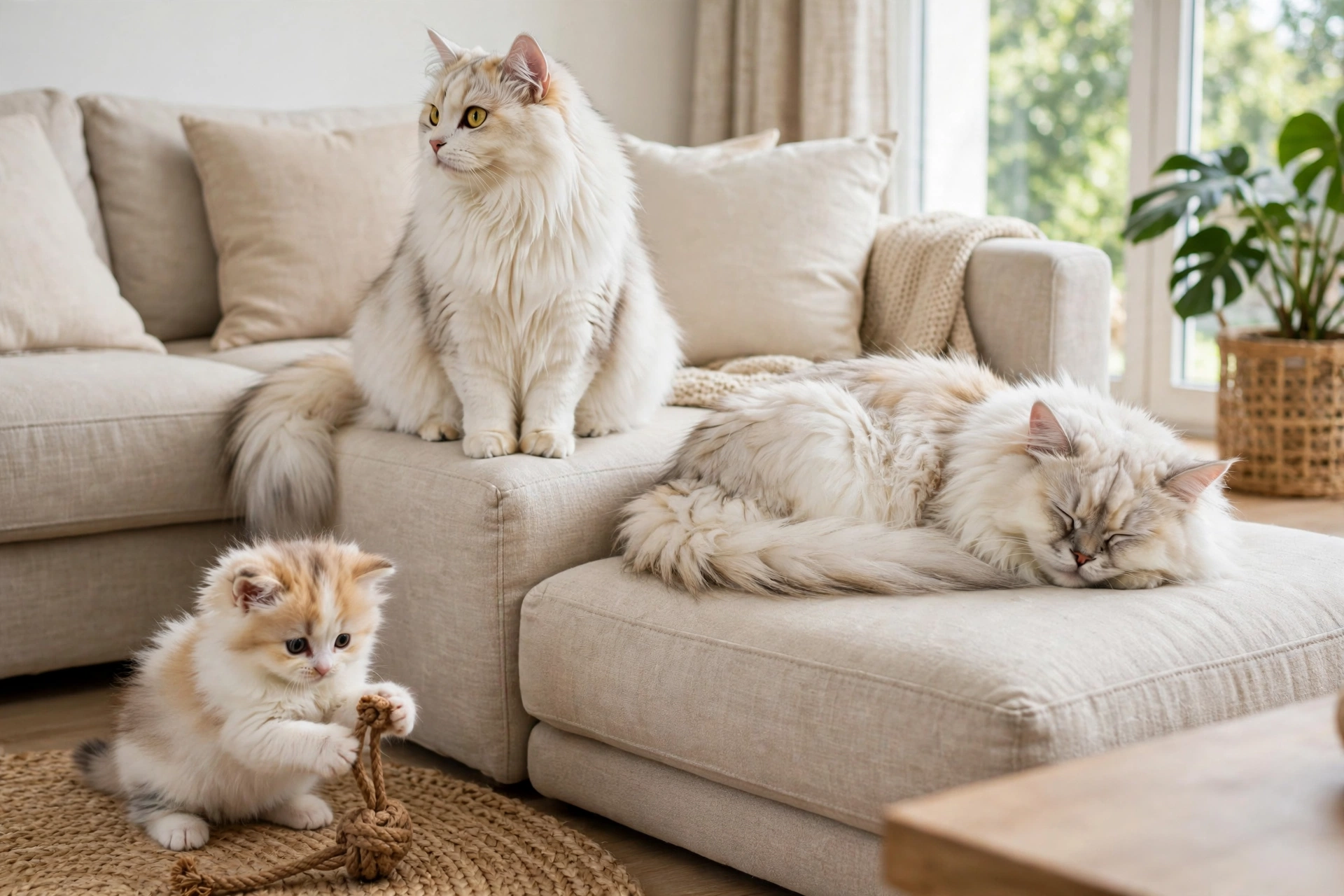
Cat Life Stages and Human Years
Veterinarians divide a cat life into stages, and a cat reaches 15 human years at age 1 and 24 human years at age 2, then ages about 4 human years per year. The American Veterinary Medical Association (AVMA) conversion gives the stage table its human year column. Stage names follow the International Cat Care framework used by clinics in the United States and the United Kingdom. A 7 year old cat, for example, sits in the mature stage at 44 human years, and the mature stage is the point where weight gain and early kidney changes start.
| Life stage | Cat age | Human years equivalent | Care focus |
|---|---|---|---|
| Kitten | Birth to 6 months | Birth to 10 human years | Vaccinations, neutering decision, growth checks |
| Prime | 3 to 6 years | 28 to 40 human years | Weight control, dental checks, yearly examinations |
| Mature | 7 to 10 years | 44 to 56 human years | Blood tests, blood pressure checks, weight watch |
| Senior | 11 to 14 years | 60 to 72 human years | Checks every 6 months, kidney and thyroid screening |
| Geriatric | 15 years and over | 76 human years and over | Comfort care, pain control, checks every 6 months |
Stage changes daily care in visible ways. A kitten of 4 months needs three meals a day and a first vaccine course. A geriatric cat of 16 years needs a litter box with a low entry side and food raised off the floor. Owners don’t need the conversion for daily care, and the stage name alone tells a clinic which screening tests to run.
Indoor Cats Versus Outdoor Cats
Indoor cats live 12 to 18 years on average, and unsupervised outdoor cats live 2 to 5 years on average. PetMD prints the outdoor figure for cats that roam without supervision, and the indoor figure matches the care guide range for house cats. Traffic causes the largest share of early outdoor deaths. Cats under 5 years old die from trauma more often than from any disease in the Royal Veterinary College mortality data, and road accidents lead the trauma list. Predators and dogs kill outdoor cats in rural areas. Coyotes hunt cats across much of the United States, and a fenced yard does not stop a coyote. Disease shortens outdoor lives in a third way. Feline immunodeficiency virus (FIV) and feline leukemia virus (FeLV) spread through bites during fights, and both viruses weaken the immune system for years before death. A supervised outdoor routine changes the maths. A cat walked on a harness, for example a 3 year old tabby walked 20 minutes a day, keeps the indoor risk profile and still gets outdoor time.
Which Factors Change How Long a Cat Lives?
Housing, body weight, neutering, dental health, diet and veterinary care change how long a cat lives, and housing carries the largest effect. Each factor below carries a published figure or a named mechanism, and owners control five of the six factors directly.
- Housing: indoor cats average 12 to 18 years, and unsupervised outdoor cats average 2 to 5 years
- Body weight: lifespan falls by about 6 months for every extra 1 kilogram (2.2 pounds) of body weight in Royal Veterinary College data
- Neutering: neutered male cats live 62 percent longer and spayed female cats live 39 percent longer in Banfield Pet Hospital data
- Dental health: dental disease affects about 70 percent of cats by age 3, and untreated dental infection loads the heart and kidneys
- Diet: a complete diet matched to life stage holds body weight steady and covers protein needs at every stage
- Veterinary care: yearly examinations catch kidney disease and thyroid disease at a stage where treatment still works
Weight deserves a worked example. A British Shorthair at 6.5 kilograms (14.3 pounds) carries about 2 kilograms (4.4 pounds) over a healthy weight for the breed, and the Royal Veterinary College weight figure prices the excess at about 1 year of life. Food measurement fixes the problem at zero drug cost. Owners who weigh food on a kitchen scale, for example 55 grams (1.9 ounces) of dry food a day for a 4.5 kilogram (9.9 pound) cat, hold weight steady far better than owners who fill a bowl by eye.

Cat Lifespan by Breed
Breed changes the average by up to 8 years between the longest lived and shortest lived breeds in published life tables. The 2024 Royal Veterinary College life table study gives the clearest breed figures, and the study counts life expectancy at birth, so study figures sit below the ranges breed clubs print. Burmese cats lead the table at 14.4 years, level with Birman cats at 14.4 years. Siamese cats reach 11.7 years at birth in the study, and Siamese cats in home care often reach the late teens because the study average includes early deaths. Crossbred cats reach 11.9 years in the study and about 14 years in care guide data, ahead of most purebred averages. Maine Coon cats sit mid range at 9.7 years in the study, and British Shorthair cats sit mid range at 9.6 years. Breed clubs print higher figures for both breeds: Maine Coon ranges of 12 to 15 years and British Shorthair ranges of 14 to 20 years describe cats that survive the early years and receive full care. Hypertrophic cardiomyopathy (HCM), a thickening of the heart muscle, limits Maine Coon lifespan and explains part of the lower study figure. Owners comparing cat lifespan by breed should ask breeders for parent health test results, because a tested Maine Coon line outlives an untested line by years.
The Oldest Cats on Record
Creme Puff, a tabby mix from Austin, Texas, holds the record as the oldest cat ever at 38 years and 3 days. Guinness World Records verified the Creme Puff record, and Creme Puff died in 2005 after a full indoor life with owner Jake Perry. The oldest living cat title passed to Flossie, a tortoiseshell from Orpington, England, at 27 years of age. Record cats share two traits across cases: indoor housing and an owner who kept veterinary records for decades. No record cat lived as an unsupervised outdoor cat. A lifespan past 30 years stays rare in every dataset, and owners should plan care around the 12 to 18 year indoor range.
Health Problems That Shorten Life in Senior Cats
Chronic kidney disease, hyperthyroidism, diabetes, arthritis and dental disease are the health problems that most often shorten life in senior cats. Chronic kidney disease (CKD) affects about 30 percent of cats over 10 years old, and kidney function loss cannot be reversed after diagnosis. Signs arrive late: a senior cat drinks more water, urinates more and loses weight across months. Hyperthyroidism is the most common hormone disorder in cats over 8 years old, and an overactive thyroid gland raises heart rate and blood pressure until treatment starts. Arthritis hides in plain sight. A 13 year old cat that stops jumping onto a sofa, for example, usually has joint pain rather than laziness, and studies of X rays find arthritis in most cats over 12 years old. Dental disease adds a steady infection load at every age. A cat with sore gums eats less, loses weight and swallows bacteria into the bloodstream at every meal. Blood tests every 6 months after age 10 catch kidney disease and hyperthyroidism at a stage where diet change and medication still add years.

How to Help Your Cat Live Longer
Owners add healthy years with six habits: indoor housing, measured food, yearly dental checks, current vaccines, parasite control and twice yearly senior checks. Each habit maps to a factor in the factors section, and the full routine costs less per year than one emergency clinic visit.
- Keep the cat indoors, or use a harness and an enclosed outdoor run for outdoor time
- Weigh the cat every month and hold an average adult at 3.6 to 4.5 kilograms (8 to 10 pounds), unless a veterinarian sets a different target
- Feed measured meals of a complete life stage diet, and record the grams per day on the food container
- Book a dental check every year, and brush the teeth of a cat that accepts a brush
- Keep core vaccines current: the FVRCP vaccine (feline viral rhinotracheitis, calicivirus and panleukopenia vaccine) and the rabies vaccine
- Apply flea treatment every month and deworm on the schedule a veterinarian sets
- Book veterinary checks every 6 months after the cat reaches 10 years, with blood pressure and blood tests at each visit
Small homes manage the routine well. A studio apartment cat, for example a 5 kilogram (11 pound) rescue tabby, needs a scratching post, a window perch and 15 minutes of play twice a day to hold weight and muscle. Muscle loss predicts frailty in old cats, and daily play protects muscle at zero cost.
Conclusion
A cat kept indoors, held at a healthy weight and checked by a veterinarian twice a year after age 10 holds the strongest path to 18 years and beyond. The averages give owners a clear order of work: housing first, weight second, screening third. Breed sets the starting range, and daily care decides where inside the range a cat lands. A neutered domestic shorthair of 4 kilograms (8.8 pounds) living indoors in 2026 carries a life expectancy of 12 to 18 years on current data.
Keep exploring: try our cat age calculator, read about cat obesity and weight loss, and see cat care basics.
Frequently Asked Questions
How long do indoor cats live?
Indoor cats live 12 to 18 years on average, and many indoor cats reach 20 years. Indoor housing removes traffic, predators and fight infections, the three causes that cut outdoor lives short.
Do neutered cats live longer than unneutered cats?
Yes, neutered cats live longer than unneutered cats. Banfield Pet Hospital data shows neutered males living 62 percent longer and spayed females living 39 percent longer than unneutered cats.
Which cat breed lives the longest?
Burmese cats live the longest in published life tables, at 14.4 years of life expectancy at birth. Birman cats match the Burmese figure, and Burmese cats in home care often pass 18 years.
How old is a 10 year old cat in human years?
A 10 year old cat is 56 in human years. Cats reach 15 human years at age 1 and 24 human years at age 2, then age about 4 human years per year.
Can an outdoor cat live for 20 years?
No, unsupervised outdoor cats do not reach 20 years. Outdoor cats average 2 to 5 years, and traffic, predators and infectious disease end most outdoor lives before age 6.
At what age is a cat a senior?
A cat is a senior at 11 to 14 years and a geriatric at 15 years and over. Veterinary checks move to every 6 months at the senior stage, with kidney and thyroid screening.
Do female cats live longer than male cats?
Yes, female cats live longer than male cats on average. The 2024 United Kingdom life table study gives females 12.5 years of life expectancy at birth, against 11.2 years for males.
Sources:
ASPCA – General Cat Care
VCA Animal Hospitals – Know Your Pet Library