Your dog does not bark to annoy you. Every bark carries a reason, and the fastest results come from matching the fix to that reason. A dog barking at the front window needs a different plan from a dog barking for your dinner, even though both sound equally loud at 10 p.m. This guide shows you how to stop dog barking by first naming the type, then training a reliable quiet cue, then removing the payoff that keeps the habit alive. Most owners see fewer and shorter barking episodes within 2 to 3 weeks of daily 5 minute practice sessions.
Why Does Your Dog Bark? Identify the Type First
Six barking types cover almost every case: alert, demand, boredom, anxiety, territorial and reactive barking. Naming the type tells you which fix to use first, because a bored dog needs activity while an anxious dog needs calm exposure and support. Sound alone rarely gives the answer. Body posture, timing and location reveal far more, so watch what happens in the 10 seconds before the first bark. Take Bella, a 2 year old Beagle who barked at 6:40 a.m. daily. Her owner tracked the sound for 3 mornings and found a jogger passing at the same time each day, which made the case alert barking rather than a toilet request. Use this table to match what you see with the first fix to try.
| Barking type | Common signs and triggers | First fix |
|---|---|---|
| Alert | Sharp repeated barks at sounds, visitors or movement; ears forward, body facing the source | Thank the dog once, then use the quiet cue and reward silence |
| Demand | Barks while staring at you, your food, a toy or the door; pauses to check your reaction | Remove every payoff, wait for 5 seconds of silence, then give what the dog wanted |
| Boredom | Monotone barks in long bouts during low activity hours; restless pacing between episodes | Add exercise, sniffing time and a puzzle feeder before the usual barking hour |
| Anxiety | Barking starts within 30 minutes of you leaving; panting, pacing, drooling or damage near doors | Shorten absences, build alone time slowly and ask your vet about anxiety support |
| Territorial | Intense barking at people or dogs near your home, yard or car; stiff body, raised tail | Block the view, create distance and reward calm looks toward the trigger |
| Reactive | Barking with lunging on leash at dogs or people; hard stare, raised hackles, weight shifted forward | Work below threshold distance, reward disengaging and book a certified trainer early |

How Do You Find the Trigger Behind the Barking?
A 3 day barking log finds the trigger in most homes. Guessing wastes weeks, since how to stop dog barking depends entirely on why the barking starts in your home. Write down the time, place, what happened just before, how long the barking lasted and what ended it. Patterns appear quickly once you have 10 to 15 entries in front of you. Phone video helps during work hours, because many dogs bark hardest in the first 30 minutes after the house empties. Neighbors can fill the remaining gaps in apartment buildings, and most will share times gladly once they know you are fixing the problem. One owner in Austin learned her Corgi barked only on trash days, when truck brakes squealed at 7:15 a.m. outside his window. She moved his bed to a back room and played a radio at low volume on those mornings, cutting episodes from 20 minutes to under 3 minutes within a week.

How to Stop Dog Barking With the Quiet Cue, Step by Step
The quiet cue works when you reward silence in short, timed steps. Shouting over your dog adds noise and excitement, and excited dogs bark longer. Train in a calm room first, using pea sized pieces of chicken, cheese or hot dog as high value treats. Keep early sessions to 5 minutes, 2 or 3 times a day, and follow these steps in order.
- Let your dog bark 2 or 3 times at a mild trigger, such as a recorded door knock played at low volume.
- Say “quiet” once in a calm, firm voice, then hold a treat close to your own nose so your dog turns to look at you.
- Wait for a pause in the barking. Sniffing toward the treat usually buys you 3 to 4 seconds of silence during the first attempts.
- Mark that silence with a cheerful “yes,” then feed the treat and praise in a low, steady voice.
- Repeat the sequence 5 to 8 times, ending the session while your dog still wants another round.
- Stretch the silence gradually across several days: reward after 2 seconds of quiet, then 5, 10, 20 and finally 30 seconds.
Real life practice comes last. Use the cue at the front door only after your dog answers it 8 times out of 10 in the calm room, because skills learned at low distraction fail at high distraction. Sam, a rescue Terrier in Chicago, needed 11 days to reach that mark at his window, and his owner kept sessions short enough that he never practiced failing.
How Do You Stop Demand Barking Without Giving In?
Demand barking ends when barking stops buying anything. Eye contact counts as payment. Talking, touching, opening the door and handing over food all teach the same lesson, which is that louder and longer works. Turn away or step out of the room the moment demand barking starts, and stay turned until you count 5 full seconds of silence. Maya’s Pug barked through dinner for 9 minutes on night one, 4 minutes on night three and only once on night six before sitting quietly. Expect a rough patch around day 2 or 3 during your first week. Trainers call this an extinction burst, and the dog tests the old method harder before giving it up. Every person in the house must follow the same rule during that week, because one person giving in restarts the training clock. Offer a legal way to ask instead: a sit in front of you, a nose touch to your hand or a toy dropped at your feet earns the walk, the game or the meal.
How Much Exercise and Enrichment Keep a Dog Quiet?
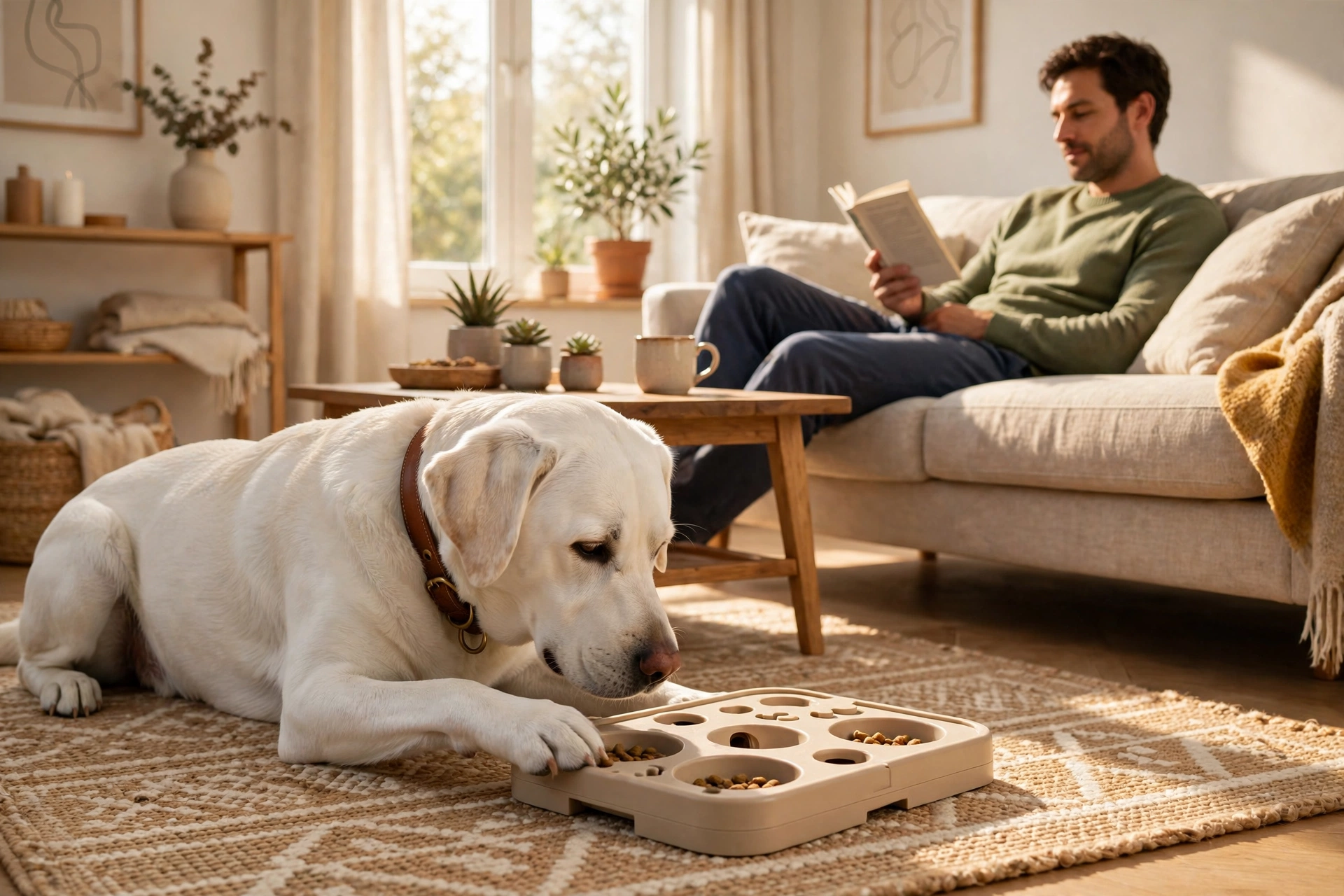
Most adult dogs settle best with 60 to 90 minutes of activity spread across the day. High energy breeds such as Border Collies and young Labradors often need 90 to 120 minutes, while most seniors do well on 30 to 60 minutes of gentle movement. Puppies need a different formula: 5 minutes of structured exercise per month of age, twice a day, plus free play and plenty of sleep. Mental work tires dogs faster than plain walking alone. A 20 minute sniff walk, where your dog chooses the pace and investigates every curb, can settle a dog as well as a much longer brisk walk. Puzzle feeders stretch a 5 minute meal into 15 to 20 minutes of focused work, and a frozen stuffed food toy can hold attention for 30 to 45 minutes during your busiest hour. Rotate 4 or 5 toys every 2 days so each one feels new again, and book the biggest activity bout before the time your dog usually barks. One Denver owner moved the long walk from 6 p.m. to 6:30 a.m. and handed over a frozen toy at 7:45 a.m., and her Shepherd’s midday barking dropped within 4 days.
How Do You Stop Barking at Windows, Doors and Passersby?
Blocking the view stops window barking faster than any cue alone. Frosted window film on the lower 24 to 36 inches of street facing glass removes the visual trigger while light still enters the room. Move sofas and dog beds away from that glass as well, because a raised perch gives your dog a guard post with a perfect view. Sound control covers the rest of the problem. A radio, television or white noise machine near the front door masks footsteps and hallway chatter in apartment buildings. Practice with recorded doorbells next: play the sound at low volume, reward 3 seconds of calm, and raise the volume in small steps across 5 to 7 days. Set up a mat or bed 6 to 10 feet from the door and pay your dog with treats for settling there when real visitors arrive, which gives barking a replacement job with clear rules.
How Do You Keep the Peace in an Apartment or With Close Neighbors?
Early honesty with neighbors buys you the time training needs. Tell the people beside, above and below you that your dog has a barking problem, that training has started and that you want a text when noise crosses the line. A short note with your phone number slipped under 3 or 4 doors costs 10 minutes and prevents the first complaint from becoming a lease problem. Scheduling protects quiet hours next. Walk and play with your dog before 9 p.m. in buildings with evening quiet rules, and arrange a midday walker or daycare on days you will be out longer than 6 hours. Keep a simple training log with dates and episode lengths, because documented progress carries weight with landlords and animal control officers. Check your lease and local noise ordinance during week one as well, since many cities measure complaints by repeated episodes longer than 10 to 20 minutes.
What Should You Never Use to Stop Dog Barking?
Punishment can silence a dog in the moment while making the cause worse. Yelling teaches nothing about what to do instead, and many dogs read shouting as joining in. Spray bottles, shake cans and physical corrections raise stress, and stressed dogs bark more over the following days, not less.
Anti-Bark Collars: Why Caution Comes First
Bark collars punish the sound rather than treating the reason behind it. Shock, spray and ultrasonic models carry real risks for anxious and reactive dogs, because the dog may link the shock or spray with a child, another dog or a sound nearby, building fear around the wrong thing. Citronella and vibration collars bother some dogs less, yet trainers still treat every collar as a last resort for a calm adult dog, used only with professional guidance and never on a puppy under 6 months.
Debarking Surgery: What Owners Should Know
Debarking, called ventriculocordectomy, removes or scars vocal cord tissue so the bark sounds softer. Volume drops, but the dog still tries to bark, still feels the trigger and still needs training and anxiety care. Many veterinarians decline the surgery except as a final option after behavior work has failed, and some states restrict the procedure by law. Housing pressure feels urgent, yet a documented training plan usually protects both the dog and the lease while real change takes hold.

When Should You Call a Certified Trainer or Your Vet?
Call for help early when barking arrives with fear, aggression or a sudden change. A dog who starts barking through the night at age 8 needs a vet visit before any training plan, because pain, hearing loss, thyroid problems and canine cognitive decline all change vocal behavior. Book the vet first when you also see appetite change, restlessness, house soiling or new sensitivity to touch. Certified help has clear credentials to look for during your search. Choose a trainer certified as CPDT-KA or a behavior consultant certified through IAABC, and ask which methods they use before you book. Cases with biting, lunging or severe panic belong with a board certified veterinary behaviorist, listed under DACVB, who can pair behavior work with medication when anxiety blocks learning. Bring your 3 day barking log and phone video to the first appointment, because that record saves the professional a full session of guesswork and saves you money.
How to Stop Dog Barking: Frequently Asked Questions
Most barking problems improve within 2 to 4 weeks of consistent daily work. The answers below cover the timing, tools and setbacks owners ask about most often.
How long does it take to stop a dog from barking so much?
Most dogs show shorter, less frequent episodes within 2 to 3 weeks of daily 5 minute sessions. Habits built over years take 6 to 8 weeks, and anxiety cases often need a vet guided plan.
Can you teach an older dog how to stop dog barking?
Yes. Senior dogs learn the quiet cue at any age, provided pain and hearing loss get checked first. Keep sessions to 3 to 5 minutes, use soft high value treats and train in the calmest room.
Why does my dog bark at nothing?
Your dog likely hears or smells something you cannot, such as a distant dog, wildlife or a delivery truck. Rule out anxiety and medical causes with your vet when the pattern is new or happens at night.
Should I ignore my dog barking at night?
Check once for a real need, such as water, a toilet break or an unusual sound, then resettle your dog without play or food. Night barking that repeats for 3 nights in a senior dog needs a vet visit.
Do ultrasonic bark deterrents work?
Some dogs pause at the sound, yet many habituate within days and anxious dogs may get worse. Devices also punish quiet dogs standing nearby. Training the quiet cue gives clearer, longer lasting results for the same money.
How do I stop my dog barking when I leave the house?
Start with departures under 1 minute, then build alone time in small steps while your dog stays calm. Leave a frozen food toy, keep arrivals low key and film your dog to track real progress.
Is it okay to let my dog bark sometimes?
Yes. Alert barking of 2 or 3 barks gives useful warning and forms part of normal dog communication. Thank your dog, check the cause, then use the quiet cue so the episode ends on your signal.
What if my neighbor complains about my dog barking?
Apologize, share your training plan and give your phone number for direct texts. Log your sessions and episode lengths daily. Documented effort resolves most complaints and protects you if animal control gets involved.
What Actually Makes a Dog Stop Barking Long Term?
Dogs stop barking excessively when the trigger loses its power and silence starts paying better than noise. Identify the type first, train the quiet cue in timed steps, remove the payoff for demand barking and meet exercise needs before the noisy hours begin. Write your plan on one page, share it with everyone in the house and follow the same steps for 30 days. A dog who gets 60 to 90 minutes of activity, daily quiet cue practice and calm responses from every family member will bark less, settle faster and recover from real triggers in seconds rather than minutes.
Sources:
American Kennel Club (AKC) – Dog Training Advice
ASPCA – General Dog Care