

Your cat stretches out on the rug, and you hear it: a faint click, click, click across the floorboards. That sound means her claw tips no longer retract fully, and a trim is due. Learning how to trim cat nails at home saves you a vet fee and saves your cat the stress of a carrier trip. The job needs no special skill, just the right clipper, good light, and a cat who feels unhurried. Most owners finish a front paw in under two minutes once the routine settles in. Your first session can be far shorter, and that is fine. Two calm claws today beat eighteen stressful ones.
How Do You Know When Your Cat’s Nails Need Trimming?
Your cat’s nails need trimming when the tips stay visible at rest, click against hard floors, or catch on fabric. Healthy claws hide inside the paw while your cat relaxes, because each one is retractable. Visible tips on a sleeping cat mean growth has outpaced what scratching wears away. Catching is another clear sign. A claw that snags the sofa throw or your sweater can tear when your cat pulls free, and a torn claw bleeds and hurts. Curved tips point to a trim as well. Left alone, a curved claw keeps curling until it presses into the paw pad. Kneading gives you a third clue. Sharp points that prick through a blanket onto your legs tell you the front claws, at least, are overdue. One common example is the senior house cat whose dewclaw quietly curls toward the pad while her other claws still look fine. Once you learn how to trim cat nails, spotting these signs becomes a ten-second habit during any cuddle.

What Tools Do You Need to Trim Cat Nails?
You need cat-sized clippers, styptic powder, bright light, and a few high-value treats laid out before you start. Cat claws curve into a pointed hook, and your tool has to cut that curve cleanly. Pet stores sell three clipper styles plus electric grinders, and each style suits a different cat. The table below compares the options side by side.
| Tool | Best for | Good to know |
|---|---|---|
| Scissor-style cat clippers | Most cats and first-time owners | Curved blades cradle the claw; handles work like small scissors |
| Guillotine clippers | Small cats and kittens | The claw slides through a ring; blades need regular replacement |
| Pliers-style clippers | Thick senior nails | Spring action gives extra cutting force |
| Electric nail grinder | Cats relaxed around buzzing sounds | Files the tip down slowly; leaves no sharp cut edge |
| Human nail clippers | Not recommended | Flat blades crush the curved claw and can split it |
Human clippers cause the most confusion at the pet store. They look similar, yet their flat blades squeeze a cat’s claw flat before cutting, and that pressure splits the claw wall. Split edges feel rough, catch on carpet, and leave the claw sore for days. Styptic powder is your safety net. A pea-sized amount pressed onto a nicked tip stops bleeding fast, and plain cornstarch from the kitchen works as a stand-in. Add a large towel for reluctant cats and a phone flashlight for dim rooms. Set everything within arm’s reach, like the owner who lines up clippers, powder, and chicken treats on the sofa cushion before her cat even arrives.

Where Is the Quick, and How Much Nail Should You Cut?
Cut only the clear, curved tip, roughly 1-2 mm at a time, and keep your cut at least 2 mm away from the pink quick. The quick is the living core inside every claw. Blood vessels and nerves run through it, so cutting into it causes pain and bleeding. Clear claws make the job easy. Hold the paw up toward a window and the quick shows as a pink triangle that starts at the base and ends well before the pointed tip. Everything past that pink zone is dead keratin. That outer section is the part you remove. Angle your blades at about 45 degrees so the cut follows the claw’s natural slant. Thin slices keep you in control. Take 1 mm, look again, and take another slice when the tip still hooks. Darker claws hide the quick, so stop earlier on those. A cat with one chocolate-brown claw among clear ones, for instance, gets tip-only trims on that claw while the rest get a standard cut.
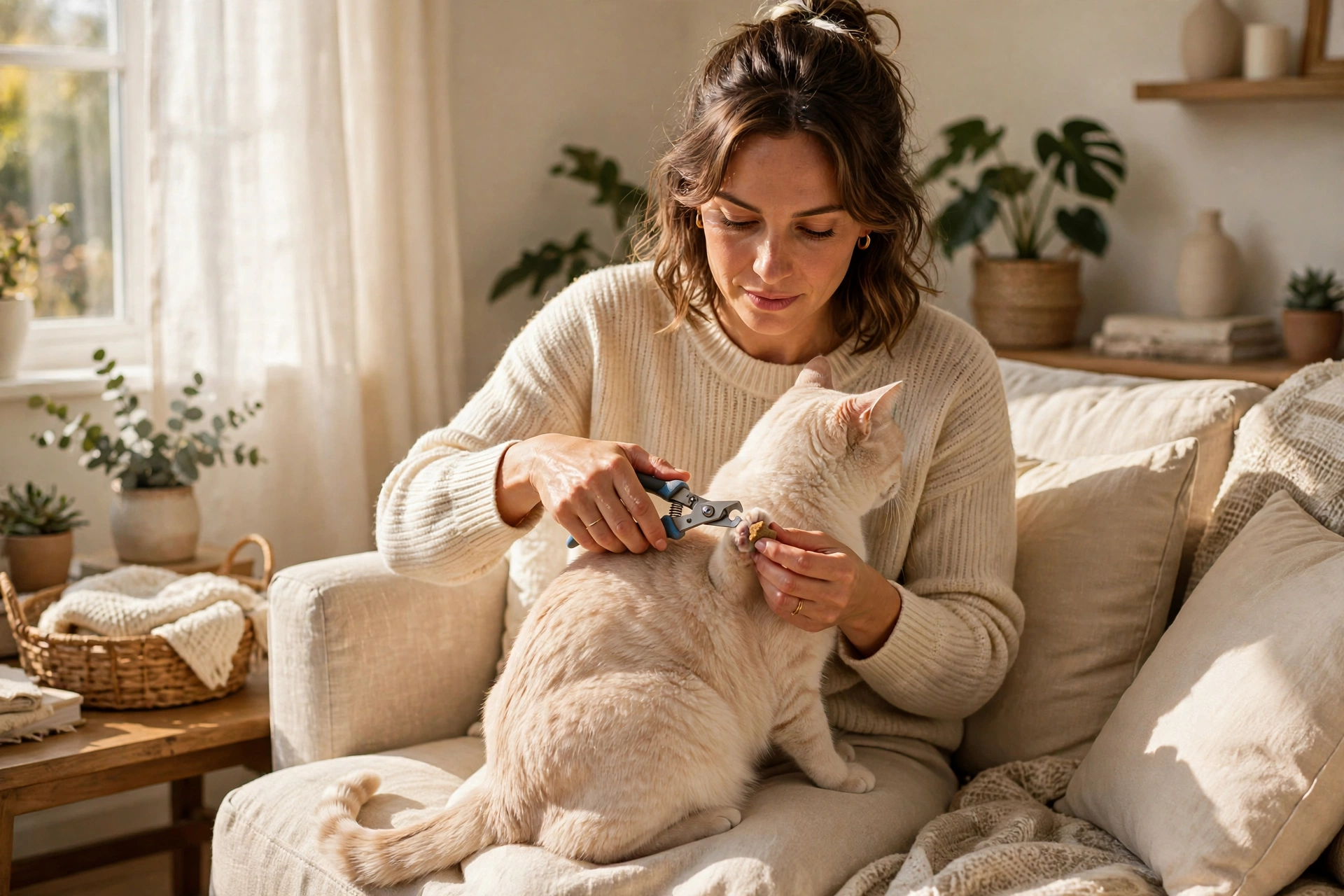
How to Trim Cat Nails Step by Step
The routine has four moves: settle your cat, extend one claw, clip the tip, then treat and pause. Work through all 18 claws only when your cat stays relaxed. Most cats carry five claws on each front paw, including the dewclaw, and four on each back paw. Front claws grow faster and stay sharper, so most sessions focus there.
Step 1: Settle Your Cat in Your Lap
Pick a quiet room and a sleepy moment, such as right after a meal. Sit your cat in your lap facing away from you, with her back resting against your stomach. This position keeps her from backing up and lets both front paws rest near your hands. A helper can hold the cat or feed treats if yours wriggles. Some owners drape a forearm gently across the cat’s shoulders for steadiness. Wait until her breathing slows before you touch a paw.
Step 2: Extend One Claw
Hold one front paw in your non-dominant hand. Place your thumb on top of the toe and a finger under the pad, then press gently. Pressure on the pad pushes the claw out of its sheath. Keep the pressure soft. Squeezing hard makes cats pull away, and a pulled paw mid-cut is how accidents happen. Look at the extended claw in good light and find the pink quick before the clippers come anywhere near it.
Step 3: Clip the Tip at a 45-Degree Angle
Slide the claw into the clipper blades with your cut line at least 2 mm from the quick. One firm squeeze gives a clean cut. Hesitating halfway through crushes the claw instead of cutting it. Move to the next toe and repeat the press, check, and clip sequence. Do not skip the dewclaw. That small claw sits higher on the inner front leg, never touches the ground, and curls into the pad faster than any other claw.
Step 4: Treat, Praise, and Take Breaks
Give a treat after each paw, not just at the end. Short breaks keep your cat’s stress low and teach her that clippers predict chicken. Watch her body language between toes. Flattened ears, a lashing tail, or growling means the session ends for today. Plenty of owners trim two claws per evening across one week during the first month, and their cats accept full sessions by week five.
How Do You Train a Kitten to Accept Nail Trims?
Kittens accept nail trims for life when you pair paw handling with treats daily during their first weeks at home. Start with touch alone. During a cuddle, hold one paw for three seconds, release it, and hand over a treat. Repeat that sequence five times, then switch to play. Add pad pressure on day three or four. Press one pad, let the tiny claw slide out, release, and treat again. Sound comes next in the training plan. Clip a piece of dry spaghetti near the kitten while she eats a treat, so the snip noise links to food instead of fear. First real trims take just the needle-sharp points. A 10-week-old kitten usually tolerates two or three claws per session, spaced across a lazy Sunday afternoon. Keep each session under a minute. Ending while the kitten stays happy matters more than finishing all 18 claws.
How Do You Trim the Nails of a Cat That Will Not Sit Still?
A towel wrap that covers the body and leaves one paw out turns a wriggly cat into a manageable one. Lay a large bath towel flat on a table. Set your cat in the center, then fold one side snugly over her body and tuck it under her weight. Fold the other side over to complete the wrap, leaving her head free. Vets call this wrap a purrito, and it stops the legs from scrambling without any force. Draw one front paw out of the towel’s front edge. Trim that paw, tuck it back in, and draw out the next. Treat breaks still apply during a wrap session. Feed a lickable treat throughout if a helper is present, since steady licking occupies most cats better than praise does. Rotate paws across days when your cat’s patience runs out. One paw per evening, four evenings a week, finishes the full set without a single wrestling match. Stop for the day if she growls, pants, or struggles hard against the towel. A vet or groomer can finish the job, and your vet can also discuss short-term calming medication for cats with true handling phobias.
How Do You Trim a Senior Cat’s Nails?
Senior cats need claw checks every week or two because their nails grow thicker and shed their outer layers more slowly. An older cat’s sheath, the flaky outer shell of the claw, sticks instead of peeling away during scratching. Layers build up, and the claw turns thick, dull, and strongly curved. Arthritis adds a second problem. Stiff toes hurt when you press the pad, so work slowly and support the whole paw in your palm. Pliers-style clippers earn their place here. Their spring handles cut through thick keratin that defeats small scissor clippers. Take thin slices with older nails. Thick senior nails split lengthwise if you bite off too much at once. Check the paw pads at every session. A claw that has already pierced the pad needs a vet, not home trimming, because pulling it free yourself can tear the wound wider. Fourteen-year-old cats often arrive at the vet with one curled dewclaw hidden under long fur, which is exactly why the weekly check matters.
What Should You Do If You Cut the Quick?
Press styptic powder firmly onto the nail tip for 10-15 seconds, and most quick nicks stop bleeding within 5-10 minutes. Stay calm first. Your cat reads your reaction, and a panicked grab at the paw makes her yank it away. Dab the powder onto the cut end with your fingertip, or press the nail directly into a small pile of it. Cornstarch, flour, or the edge of a dry bar of soap works when the powder is missing. Hold your cat quietly in your lap while the clot forms. Walking around too soon can knock the clot loose and restart the bleeding. Skip further trimming that day. The claw will feel tender, and one bad memory can undo weeks of treat training. Call your vet if bleeding continues past 20 minutes, if the claw hangs at an odd angle, or if the toe swells over the next two days. A single nick during a cat’s first home trim, handled this way, typically heals with no further treatment at all.

How Often Should You Trim Cat Nails?
Most indoor cats need a trim every 2-3 weeks, and a ten-second claw check once a week keeps the schedule honest. Growth speed varies with age, activity, and how much scratching your cat does. Outdoor cats wear their tips down on trees and concrete, so their trims stretch further apart. Kittens sit at the other extreme. Their claws grow fast and start out needle sharp, so small tip trims come more often. The schedule below gives a workable pattern for each group.
| Cat group | Claw check | Trim |
|---|---|---|
| Kitten (under 6 months) | Twice a week | Every 1-2 weeks, tips only |
| Adult indoor cat | Once a week | Every 2-3 weeks |
| Adult cat with outdoor access | Every 2 weeks | Every 3-4 weeks, or as needed |
| Senior cat (10 years and older) | Every 1-2 weeks | Every 2 weeks |
Scratching posts support this schedule but never replace it. A post sharpens and conditions the claws, yet it removes very little length from the tip. Pair a tall post beside your cat’s favorite nap spot with regular trims, and the claws stay both healthy and blunt.
Frequently Asked Questions About How to Trim Cat Nails
Most owner questions cover tools, claw counts, back paws, and what counts as an emergency. Short answers sit below, with the full detail in the sections above.
Can I use human nail clippers on my cat?
No. Human clippers squeeze a cat’s curved claw flat before cutting, and that pressure can split the claw wall. Cat clippers have curved blades that match the claw’s shape. A basic scissor-style pair costs only a few dollars.
How many claws does a cat have?
Most cats have 18 claws: five on each front paw, including the dewclaw, and four on each back paw. Polydactyl cats carry extra toes, and each extra toe usually has its own claw that also needs trimming.
Do you need to trim a cat’s back claws?
Yes, but less often. Back claws wear down through jumping and running, yet they still thicken and curl, mainly in older cats. Check them at every session and trim the tip when it looks long or hooks.
How do you find the quick in a dark claw?
Shine a phone flashlight behind the claw so the pink quick shows through as a shadow. Trim 1 mm slices and stop when the sharp hook is gone. Leaving a dark claw slightly long beats cutting it short.
Is it okay to trim one paw at a time?
Yes. Spreading the job across several days keeps stress low and still gets every claw done. Trim one paw, give a treat, and finish the rest later that week. Many nervous cats learn the routine faster this way.
Should outdoor cats get nail trims?
Give outdoor cats light tip trims, or skip trimming if their claws stay a healthy length. Outdoor cats climb fences and may need their claws for defense, so keep the points stronger than you would for an indoor cat.
What if a claw has already curled into the paw pad?
Book a vet visit instead of trimming it at home. A claw embedded in the pad usually means a wound, and possibly infection, under the surface. Your vet can remove the claw tip safely and prescribe treatment afterward.
Conclusion
Short sessions, small cuts, and a treat after every paw turn nail trims into a two-minute routine. You now know how to trim cat nails with the right tool, where the quick sits, and how kittens, seniors, and reluctant cats each need a slightly different approach. Set a reminder for the next claw check while this session stays fresh in your mind. A cat has 18 claws, and ten calm minutes every 2-3 weeks keeps every one of them at a safe, comfortable length.
Sources:
ASPCA – Cat Grooming Tips
ASPCA – General Cat Care