A single cough after drinking or pulling on a lead is normal, and a repeated cough needs attention. A cough is a reflex that clears dust, mucus and inhaled material from the airways. Owners searching dog coughing usually hear a new sound at night or after a boarding stay, and the sound gives the first clue. A dry hacking cough points toward airway irritation, and a wet cough points toward fluid or infection in the lungs. Duration gives the second clue. A cough that lasts more than 7 days needs a veterinarian visit, and a cough with breathing difficulty needs emergency care on the same day. A 4 kilogram (8.8 pound) Yorkshire Terrier with a honking cough, for example, faces a different cause list from a 30 kilogram (66 pound) Labrador Retriever with a soft cough at night.
Is Coughing Normal in Dogs?
Yes, occasional coughing is normal in dogs, and daily coughing is not normal in dogs. Healthy dogs cough to clear the throat after drinking fast, after inhaling dust, or after a collar pulls against the neck. A normal cough happens once or twice, and the dog then eats, plays and breathes at a normal rate. Pattern separates a normal cough from a problem cough. Record four facts on day one: the sound, the time of day, the trigger, and the number of episodes in 24 hours. A video recording on a phone helps a veterinarian more than a spoken description at the clinic. A Beagle that coughs twice after running through dry grass in October, for example, shows a normal pattern. A Beagle that coughs 15 times a day for 4 days shows a problem pattern, and the problem pattern needs a diagnosis.

What Do Different Dog Coughs Sound Like?
Sound gives a veterinarian the first sorting tool, and four cough types cover most cases seen in clinics. A dry hacking cough sounds harsh and produces no mucus. A honking cough sounds like a goose call and comes from the trachea (windpipe). A wet productive cough sounds moist and can end with swallowing or white foam at the mouth. Timing adds detail beside sound: kennel cough often worsens with excitement, and a heart related cough often worsens at night or during rest. Owners should write the sound in plain words, if a recording fails. One common record, a Poodle coughing in short honks after drinking water, tells a veterinarian to examine the trachea first.
| Cough type | Sound | Causes a veterinarian may check | Action timing |
|---|---|---|---|
| Dry hacking cough | Harsh, repeated, no mucus | Kennel cough, chronic bronchitis, airway irritation | Book a visit, if the cough lasts over 7 days |
| Honking cough | Goose honk, often after excitement or collar pressure | Tracheal collapse, kennel cough | Book a visit within 2 to 3 days |
| Wet productive cough | Moist, rattling, mucus or foam possible | Pneumonia, bronchitis, fluid in the lungs | Book a visit the same day |
| Soft cough at night | Quiet, repeated, worse during rest | Heart disease, fluid build up in the lungs | Book a visit within 24 hours |
| Reverse sneeze episode | Loud snorting inhalation through the nose | Nasal irritation, not a cough | Monitor at home, if episodes stay short and rare |
One limit applies to every row in the table. Sound alone never confirms a cause, and only an examination with tests confirms a cause in a coughing dog.
What Is Kennel Cough in Dogs?
Kennel cough is the most common infectious cause, and kennel cough is a group of viruses and bacteria rather than one germ. The full medical name is canine infectious respiratory disease complex (CIRDC), and the bacterium Bordetella bronchiseptica is the agent named most often in cases. Dogs catch kennel cough at boarding kennels, daycare centres, grooming salons, training classes and dog parks. Signs start 2 to 14 days after exposure, per the American Kennel Club (AKC). The classic sign is a forceful dry cough that ends with gagging or retching, and many owners report that the dog seems to choke on an object. Most healthy adult dogs recover in 1 to 3 weeks with rest alone. Puppies under 6 months, senior dogs and dogs with weak immune systems face a higher risk, because kennel cough can progress to pneumonia in the three groups. A vaccinated dog can still catch kennel cough, since vaccines cover selected agents and reduce severity rather than blocking every agent. A Labrador Retriever that starts honking 5 days after a boarding stay, for example, matches the classic exposure pattern a veterinarian expects.
Can a Collapsing Trachea Cause Coughing in Small Dogs?
Yes, a collapsing trachea causes a chronic honking cough in small and toy breeds. Cartilage rings hold the trachea open, and weakened rings flatten during breathing and narrow the airway. PetMD describes the resulting cough as a goose honk, and excitement, exercise, drinking and collar pressure trigger episodes. Yorkshire Terriers, Pomeranians, Toy Poodles and Chihuahuas carry the highest rates, and overweight dogs cough more often than lean dogs of the same breed. Tracheal collapse is a long term condition rather than an infection, so antibiotics do not fix the flattened rings. Management rests on weight control, a harness instead of a collar, and medication a veterinarian prescribes for cough control. A 3.5 kilogram (7.7 pound) Pomeranian that honks during every walk, for example, needs a harness fitting and a weight check before any drug discussion.
Can Heart Disease Cause a Dog to Cough?
Yes, heart disease causes coughing in dogs, and the cough often grows worse at night. A failing heart pumps blood with less force, and fluid can build inside the lungs in congestive heart failure (CHF). An enlarged heart can also press on the main airways and trigger a soft, moist cough during rest. Mitral valve disease is the common heart cause in older small dogs, and dilated cardiomyopathy is the common heart cause in large breeds such as the Doberman Pinscher. Company signs separate a heart cough from an infection cough: low stamina on walks, fast breathing during sleep, fainting and a swollen belly. Owners can count resting breaths at home during sleep. A sleeping dog normally takes under 30 breaths per minute, and a rate over 30 breaths per minute on 2 separate nights needs a veterinarian call within 24 hours. A 9 year old Cavalier King Charles Spaniel coughing at 2 in the morning, for example, needs a heart examination before a cough medicine discussion.
What Other Conditions Cause Dogs to Cough?
Pneumonia, canine influenza, foreign bodies, allergies and irritants fill the rest of the common cause list. Pneumonia is infection or inflammation inside lung tissue, and pneumonia produces a wet cough with fever, low appetite and fast breathing. Normal dog temperature runs 38.3 to 39.2 degrees Celsius (101 to 102.5 degrees Fahrenheit), and a temperature above 39.7 degrees Celsius (103.5 degrees Fahrenheit) counts as a fever. Canine influenza virus spreads between dogs in shelters and daycare centres, and canine influenza produces cough, fever and nasal discharge for 2 to 4 weeks. Foreign bodies trigger a sudden violent cough in a dog that ran through long grass: grass awns (foxtails), stick fragments and bone pieces can lodge in the airway and need removal with an endoscope. Allergies to pollen, dust mites and mould inflame airways in seasonal patterns, and cigarette smoke, aerosol sprays and cleaning fumes irritate airways in any month. Chronic bronchitis produces dog coughing on most days for 2 months or longer, with a dry hacking cough as the recorded sound. Heartworm disease, spread by mosquito bites, damages the heart and lungs and produces a soft cough with low stamina in dogs that miss monthly prevention. A Golden Retriever coughing with fever 3 days after swimming and inhaling water, for example, needs a pneumonia check on the same day.
Is Reverse Sneezing the Same as Coughing?
No, reverse sneezing is not a cough, and reverse sneezing needs no treatment in most dogs. A reverse sneeze is a rapid, loud inhalation through the nose, and Cornell University College of Veterinary Medicine lists the medical name as paroxysmal respiration. During an episode the dog stands still, stretches the neck forward and snorts repeatedly for 10 to 60 seconds. Irritation at the back of the nose starts the reflex: dust, pollen, excitement, fast drinking and collar pressure are recorded triggers. Episodes end without help, and the dog breathes normally between episodes. Owners should book a visit, if episodes grow frequent, last longer than 1 minute, or arrive with nasal discharge or nose bleeding. A French Bulldog snorting after a dusty walk, for example, shows a classic harmless episode, while a French Bulldog snorting 10 times a day with green discharge needs an examination.
What Can You Do at Home for a Coughing Dog?
Home care supports comfort and rest, and home care never replaces a diagnosis. Four steps carry the home plan for a dog that eats, drinks and breathes normally between coughs.
- Run a hot shower and sit with the dog in the steamy bathroom for 10 to 15 minutes, 2 times a day
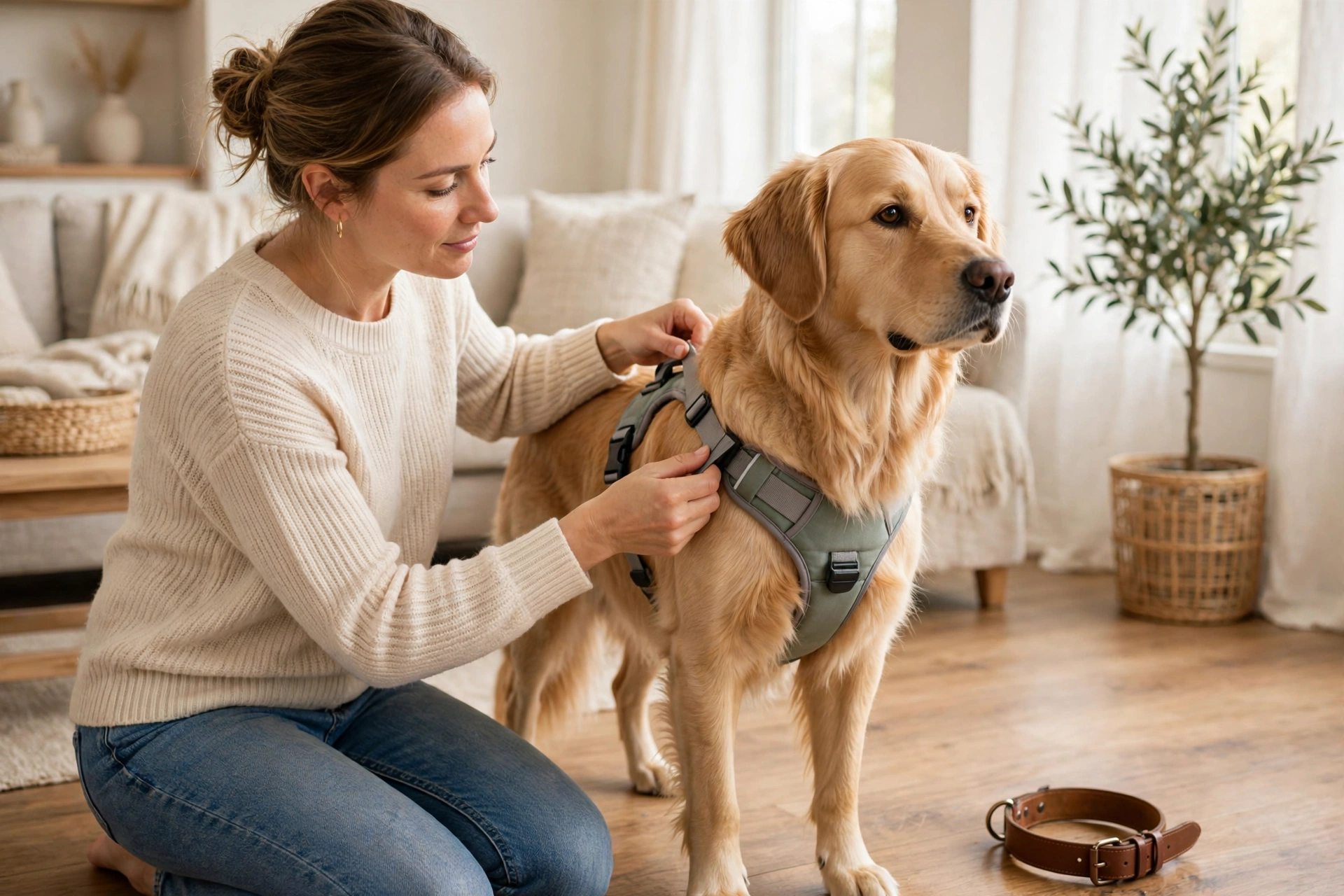
- Fit a harness for every walk and remove the collar load from the trachea
- Cut exercise to short toilet walks for at least 7 days
- Isolate the dog from other dogs during the cough and for at least 2 weeks after the last cough, if a veterinarian suspects kennel cough
Fresh water stays available at all hours, and food stays plain and measured at the normal ration in grams and ounces for the dog weight. Smoke, scented sprays and dust leave the rooms the dog uses. Human cough medicines stay in the cabinet: cough drops can contain xylitol, a sweetener toxic to dogs, and human syrups carry doses built for human body weight. Honey has no proven cough benefit in dogs and adds sugar at 21 calories per teaspoon, 7 grams (0.25 ounces). A Border Collie with a mild dry cough and a normal appetite, for example, gets steam sessions, harness walks and rest at home, plus a booked visit on day 3 for a recorded check.

When Does a Coughing Dog Need a Veterinarian?
Emergency signs need a clinic today, and persistent signs need a booked visit inside 7 days. The two lists below separate the speeds, and owners should act on the first matching line rather than the full list.
- Emergency today: coughing blood, in any amount
- Emergency today: blue, purple or pale gums
- Emergency today: breathing difficulty, gasping or open mouth breathing at rest
- Emergency today: collapse or fainting during or after a cough
- Emergency today: a puppy under 6 months with repeated coughing and low appetite
- Book a visit: a cough lasting more than 7 days, or a cough growing worse across 48 hours
- Book a visit: fever, nasal discharge, eye discharge or repeated sneezing beside the cough
- Book a visit: a senior dog over 8 years with a new cough
- Book a visit: a dog with a known heart murmur or heart disease and any new cough
- Book a visit: weight loss, low stamina or a resting breathing rate over 30 breaths per minute
Owners in the United States can call the ASPCA Animal Poison Control Center at (888) 426-4435, if a cough follows access to rat poison or another toxin. A Dachshund that coughs blood after chewing in a garage with stored poison, for example, needs an emergency clinic first and a poison call during the drive.
What Will a Veterinarian Do for a Coughing Dog?
A veterinarian confirms the cause with an examination and tests, and treatment follows the confirmed cause. The visit starts with history: onset date, sound, triggers, boarding or daycare contact in the last 14 days, vaccination status and heartworm prevention dates. A stethoscope check covers the lungs, the airways and the heart, and gentle pressure on the trachea can reproduce a honking cough in the examination room. Tests scale with the findings: chest X-ray images for lung fluid or an enlarged heart, blood tests for infection and heartworm, and a nasal or throat swab for a polymerase chain reaction (PCR) test that names respiratory pathogens. Treatment then matches the cause: antibiotics for bacterial infection, cough suppressants for a dry cough that blocks sleep, heart medication and a diuretic for fluid in the lungs, or endoscope removal for a foreign body. A veterinarian may also set a recheck at 7 to 10 days. A Shih Tzu with a honking cough and a clear chest X-ray, for example, leaves with a harness plan and cough medication rather than antibiotics.
Conclusion
A cough is a sign, never a diagnosis, and the cause decides the treatment. Kennel cough clears with rest in 1 to 3 weeks in most healthy adult dogs, and tracheal collapse, heart disease and pneumonia each need a different confirmed plan. Home care has fixed limits: steam for 10 to 15 minutes, harness walks, rest for at least 7 days, and isolation for at least 2 weeks after the last cough in suspected kennel cough cases. Blood, blue gums, breathing difficulty and collapse send a dog to an emergency clinic on the same day. A cough in a healthy adult Beagle still needs a booked visit on day 8.
Keep exploring: dog sneezing, dog panting, and our pet health calculators.
Frequently Asked Questions
Why is my dog coughing and gagging?
Kennel cough is the most common cause of coughing with gagging in dogs. Airway irritation from tracheal collapse or a foreign body can produce the same pattern. A veterinarian confirms the cause with an examination.
How long does kennel cough last in dogs?
Most healthy adult dogs recover from kennel cough in 1 to 3 weeks. Rest and isolation speed recovery. Puppies, senior dogs and dogs with weak immune systems can stay ill longer and need monitoring.
Can I give my dog human cough medicine?
No, owners must never give human cough medicine to a dog without veterinarian direction. Human syrups carry human doses, and cough drops can contain xylitol. Xylitol poisons dogs at small amounts.
Is a honking cough always tracheal collapse?
No, a honking cough has more than one cause in dogs. Kennel cough also produces a honking sound. Tracheal collapse stays on the list for small breeds, and an examination separates the two causes.
When is a dog cough an emergency?
Blood, blue or pale gums, breathing difficulty and collapse make a dog cough an emergency. Each sign needs a clinic visit on the same day. Waiting overnight risks oxygen loss in the dog.
Should a coughing dog wear a collar or a harness?
A coughing dog should wear a harness for every walk. A harness removes pressure from the trachea. Collar pressure triggers coughing episodes in dogs with tracheal irritation or tracheal collapse.
Can dog coughing spread to other dogs?
No, a coughing dog should stay away from other dogs until a veterinarian clears contact. Kennel cough and canine influenza spread through air and shared bowls. Isolation protects healthy dogs in the home.
Sources:
ASPCA – Common Dog Diseases
ASPCA – General Dog Care