
Most sneezes in a healthy dog are harmless, and short sneezing bursts clear dust and scent particles from the nose within minutes. A sneeze is a normal response to stimulation of irritant receptors in the nasal passage, in the words of Dr. Jerry Klein, Chief Veterinarian at the American Kennel Club (AKC). Owners asking about dog sneezing usually hear a burst of 3 to 6 sneezes after garden sniffing or a play fight, and the burst ends before worry is due. Pattern separates a harmless burst from a medical problem. A 12 kilogram (26 pound) Beagle, for example, sneezes twice after sniffing dry soil and returns to the garden without discharge or distress. Blood, one-sided discharge, pawing and returning fits belong to a different pattern, and the sections below sort each pattern by cause.
Three sneeze types cover nearly every episode: play sneezing during excited games, reverse sneezing with air pulled inward, and abnormal sneezing that repeats across days with discharge.
Is Dog Sneezing Normal?
Yes, occasional sneezing is a normal body response in dogs, and the sneeze exists to clear irritants from the nose. Dogs explore the world nose first, and a working nose pulls in dust, soil grains, pollen and grass fragments on every walk. One or two sneezes after sniffing clear the load. Frequency draws the line between normal and abnormal. A dog that sneezes 2 or 3 times in a day and eats, plays and sleeps normally sits inside the normal range. Beside a freshly vacuumed carpet, for example, a Cocker Spaniel sneezes hard and stops sneezing in the kitchen, and the room change names dust as the cause.
Why Do Dogs Sneeze During Play?
Yes, dogs sneeze during play as a signal to a play partner, and the play sneeze tells the other dog that rough movement is still a game. Behaviour researchers class the play sneeze as communication aimed at a wrestling partner during the most excited seconds of a game. Excitement adds a second trigger, because fast breathing pulls more air and dust across the nose lining. Timing alone identifies the play sneeze: play sneezing starts after play starts and ends within minutes of the game ending. A young Labrador Retriever, for example, sneezes between rounds of tug play with an older Border Collie, and both dogs stay loose and keen to continue. Sneezing that continues on the sofa an hour after the game ends is not play sneezing, and later sneezes belong against the warning signs in the table below.

What Is Reverse Sneezing in Dogs?
A reverse sneeze is an inward breath reflex, and air pulled in fast through the nose creates the loud snorting sound owners hear. Irritation of the soft palate, the soft tissue at the back of the mouth, starts the reflex, and spasm in the soft palate muscles narrows the airway opening as the dog pulls air inward in repeated snorts. PetMD compares the sound to a goose honk or a choking noise. Posture adds a visual clue: the dog stands still, extends the neck, and holds the elbows out while the snorts continue. Most episodes last about 30 seconds, and PetMD puts the outer limit at under 1 minute. Flat-faced breeds such as Pugs and Shih Tzus and small breeds such as Chihuahuas record more episodes than large long-nosed breeds.
Two calm actions can shorten an episode: gentle throat massage prompts swallowing, and swallowing ends the spasm for many dogs. A short gentle blow toward the face can also trigger a swallow, if the dog accepts handling during the episode. Reverse sneezing stays harmless in most dogs, and a dog returns to normal behaviour seconds after the last snort. Four patterns move reverse sneezing out of the harmless class. A first ever episode deserves a veterinarian check, because a collapsing trachea can produce a similar sound. Episodes returning many times a day need a clinic visit to find the trigger. Discharge or blood beside the snorts changes the picture at once. Collapse, struggling breath or blue gums during an episode need emergency care, not home watching.
What Irritants Make Dogs Sneeze?
Dust, pollen, perfume, cigarette smoke and cleaning sprays are the most common household irritants behind sudden sneezing fits in dogs. Scented products sit at nose height in most homes, and a dog nose meets air freshener spray, floor cleaner vapour and perfume at full strength. Yard triggers work the same way: fresh cut grass, dry soil dust and weed pollen enter the nose during sniffing. Owners can test an irritant theory in one step: move the dog to a different room or street and count the sneezes across the next 30 minutes. Counts that fall after the move point to an irritant in the first location. A West Highland White Terrier, for example, sneezes through one spring week only on morning walks, and the walk timing points to tree pollen rather than infection. Coloured discharge moves the case into the infection pattern below, because irritant sneezing carries clear fluid only.
Can a Foreign Body Make a Dog Sneeze?
Yes, a grass seed or foxtail inside the nose causes sudden, violent sneezing fits, and the fits start during one walk and continue at home. Dogs inhale seeds and awns nose first, because sniffing pulls air and particles deep into the nasal passages. Foxtails carry barbs, and barbs let a foxtail travel forward through tissue while blocking backward movement. One-sided signs mark the classic pattern: sneezing fits, pawing at one side of the nose, head shaking, and discharge or blood from one nostril. Timing gives the second clue, since foreign body sneezing starts within hours of a walk through long grass or dry weeds. A Springer Spaniel, for example, runs through a dry field at 10 in the morning and sneezes 20 times before lunch, and the same-day start points straight at a seed or awn. Home removal fails and adds risk, because owners cannot see inside the nasal passages. Veterinarians remove nasal foreign bodies under anesthesia with a camera and grasping tools, and the AKC lists anesthesia removal as the standard route for a stuck foxtail.
Can Infections and Allergies Make Dogs Sneeze?
Yes, respiratory infections and allergies both cause repeated sneezing in dogs, and discharge colour helps owners separate infection signs from allergy signs. Viruses and bacteria spread between dogs at kennels, groomers, dog parks and daycare centres, and an infected dog sneezes with a cough, watery eyes and low energy. Kennel cough and canine influenza both travel through close dog contact, and canine influenza can progress to pneumonia if owners delay care. Clear and watery discharge carries the least concern, thick yellow or green discharge points toward infection, and bloody discharge points toward infection, a foreign body or a mass. Allergies follow a different calendar. Seasonal sneezing that returns each spring with pollen fits the allergy pattern, and the AKC notes that allergies cause sneezing in dogs less often than in people. Fungal infection forms a third branch: Aspergillus fungus infects the nasal cavity of long-nosed breeds and hunting dogs in some regions, with bloody discharge from one side across weeks.
Can Dental Disease and Nasal Mites Cause Sneezing?
Yes, an infected upper tooth and nasal mites both reach the nasal cavity, and both problems produce sneezing that home care cannot settle. Upper tooth roots sit below the nasal cavity and the sinuses, separated by thin bone. A tooth root abscess (a pocket of infection at the root tip) can break into the nasal cavity, and the AKC lists abscess signs as tooth pain, sneezing, yellow discharge and swelling just below the eye. An oronasal fistula (an abnormal opening between the mouth and the nasal cavity) lets food and water enter the nose. Small older dogs carry the highest dental risk, and a 9 year old Yorkshire Terrier with bad breath and swelling under one eye needs a dental examination before any allergy treatment. Nasal mites attack from inside the nose itself. The mites measure 1 to 1.5 millimetres (0.04 to 0.06 inches) long, live inside the nasal passages, and cause sneezing, bloody discharge from both nostrils, face itching, head shaking and reverse sneezing. Diagnosis needs anesthesia and a camera inside the nose, and treatment uses veterinarian prescribed anti-parasitic drugs.
Can Nasal Tumours Cause Sneezing in Older Dogs?
Nasal tumours cause slow, one-sided sneezing in older dogs, and tumour signs build across weeks instead of starting in one day. Growths inside the nasal cavity narrow the air passage on one side and produce chronic mucus discharge from one nostril first. The AKC records nasal tumours most often in longer-nosed older male dogs, and advanced growths can push the face out of shape or make one eye bulge. Onset speed separates tumour cases from foreign body cases at home: a foxtail announces itself in one afternoon, while tumour sneezing creeps in across 3 to 6 weeks. A 10 year old German Shepherd, for example, starts with mild one-sided sneezing in one month and shows thicker discharge plus an occasional nosebleed in the next month, and the slow build is the pattern to report. Diagnosis uses X-rays or a computed tomography (CT) scan, and radiation therapy is the main treatment route named by the AKC.

How Can You Help a Sneezing Dog at Home?
Home care for a sneezing dog follows four steps: remove the irritant, add humid air, rest the dog, and record the discharge pattern. The routine suits mild cases only, meaning a bright dog with clear discharge, a normal appetite and sneezing under 1 to 2 days. Owners work through the steps in order, if the dog stays bright and comfortable.
- Move the dog away from smoke, sprays, dust and cleaning products
- Run a humidifier near the dog bed, or sit with the dog in a steamy bathroom for 10 to 15 minutes
- Rest the dog and skip dog parks, daycare and group walks until the sneezing stops
- Wipe discharge gently with a soft damp cloth and record colour, side and sneeze count each day
Bleeding after hard sneezing needs one extra measure: an ice pack held on the muzzle above the nose for 5 to 10 minutes slows a mild nosebleed, per AKC guidance. Human cold and allergy medicines stay out of reach, because many human products contain ingredients that poison dogs. Recording one episode on a phone gives the veterinarian direct evidence, and a 30 second clip often settles the reverse sneezing question in one viewing.
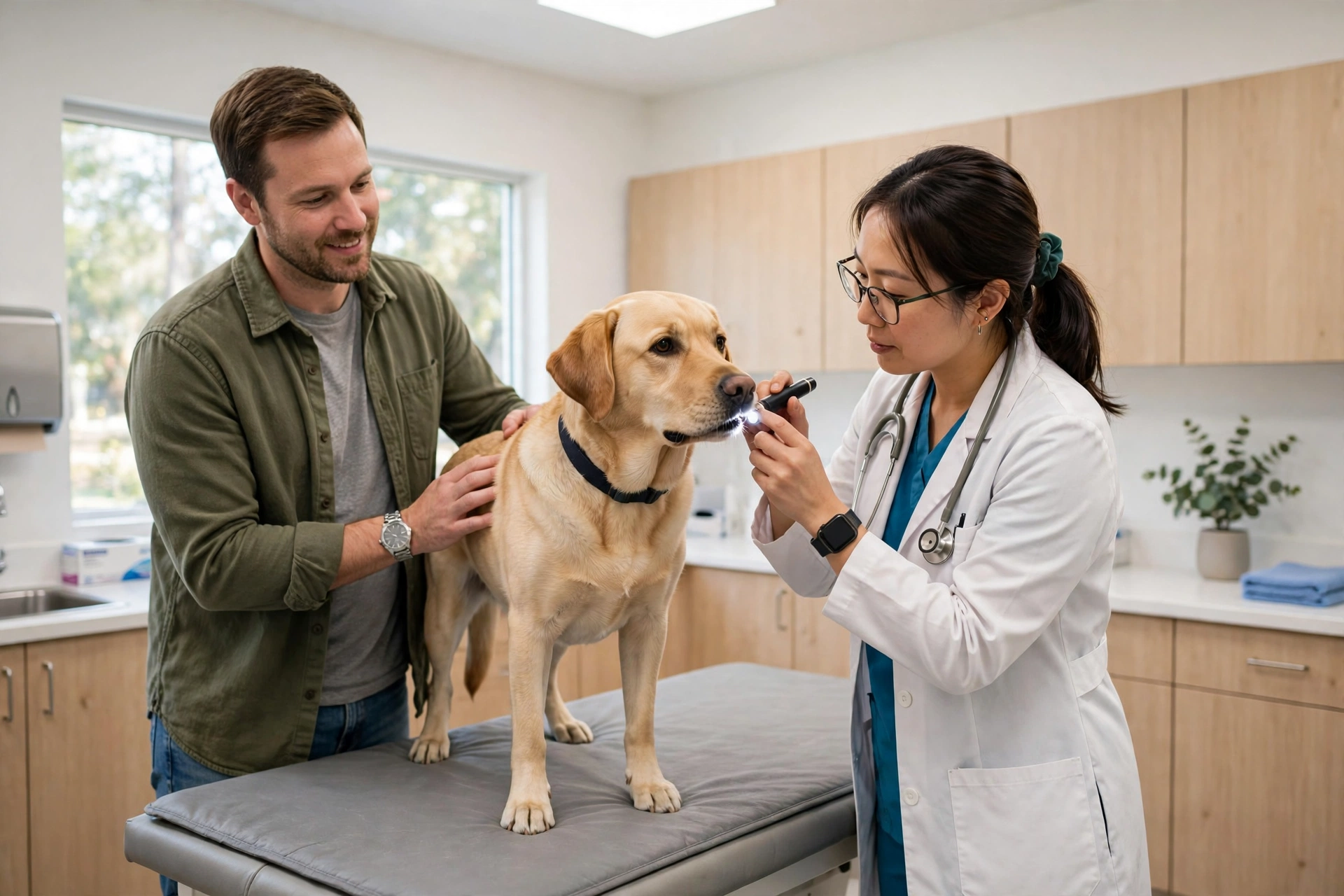
When Does Dog Sneezing Need a Veterinarian?
A veterinarian visit is due the same day after blood, one-sided discharge, facial swelling or appetite loss joins the sneezing. Owners don’t need a diagnosis before calling, and no home test can name the cause inside a dog nose. The table pairs each sign with the pattern to record and the action.
| Warning sign | Pattern to record | Action |
|---|---|---|
| Sneezing blood | Amount of blood, one nostril or both nostrils | Same day veterinarian visit, emergency care after a heavy nosebleed |
| One-sided discharge | Colour of the discharge, days the discharge has run | Veterinarian visit within 24 hours |
| Pawing at the nose | Sneezing fits after a walk in long grass or dry weeds | Same day veterinarian visit, foreign body check |
| Fits that keep returning | Episodes per day, length of each episode in seconds | Veterinarian visit to find the trigger |
| Sneezing past 1 to 2 days with discharge | Discharge colour change from clear to yellow or green | Veterinarian visit, infection check |
| Facial swelling | Swelling below one eye, tooth pain signs, bad breath | Veterinarian visit, dental examination |
| Loss of appetite | Missed meals, low energy, fever signs | Same day veterinarian visit |
Two signs skip the queue entirely. Laboured breathing between sneezes and pale or blue gums mark an emergency at any hour, and owners should drive to an emergency clinic first and phone from the car. United States owners can also call the ASPCA Animal Poison Control Center at (888) 426-4435 after a suspected poison exposure, such as rodent bait near a sneezing dog with a nosebleed.
What Will a Veterinarian Check?
A veterinarian starts with the history and a nose and mouth examination, and clinic tests follow the pattern of signs found at the visit. History questions cover sneeze frequency, discharge side and colour, recent walks and contact with other dogs. Dental examination checks the upper teeth for root infection, and a blood test checks clotting after repeated nosebleeds. Rhinoscopy (a camera on a flexible tube passed into the nose under anesthesia) lets the veterinarian see seeds, mites, fungal plaques and masses directly. Treatment matches the cause found: anesthesia removal for a foxtail, antibiotics for a bacterial infection, anti-parasitic drugs for nasal mites, and dental surgery for an abscessed tooth.
Conclusion
Sneezing protects the nose of a healthy dog, and abnormal sneezing gives owners readable signs in discharge colour, side and timing. Play sneezing ends with the game, reverse sneezing ends inside 1 minute, and irritant sneezing ends after the trigger leaves the room. Sneezing with blood, one-sided discharge, pawing, facial swelling or appetite loss belongs in a clinic the same day. A 12 kilogram (26 pound) Beagle that sneezes twice after garden sniffing and then eats a full dinner needs no clinic visit.
Keep exploring: try our pet health calculators.
Frequently Asked Questions
Is it normal for a dog to sneeze during play?
Yes, play sneezing is normal communication between dogs. The sneeze signals that rough play is still a game. Play sneezing starts during the game and stops within minutes after the game ends.
How long does a reverse sneeze last?
A reverse sneeze usually lasts about 30 seconds. PetMD puts episodes at under 1 minute. The dog stands still, extends the neck and snorts inward, then returns to normal behaviour at once.
Can dogs catch a cold from humans?
No, dogs do not catch human cold viruses. Dogs catch dog respiratory viruses from other dogs at kennels, groomers and parks. Sneezing with cough, watery eyes and low energy after dog contact needs a veterinarian call.
Why is my dog sneezing blood?
Blood can follow hard sneezing, a stuck seed, infection, a nasal growth or a clotting problem. Only a clinic examination can separate the causes. Heavy bleeding or pale gums need emergency care.
Can allergies make a dog sneeze?
Yes, pollen, dust and mould allergies can make a dog sneeze. Allergy sneezing follows a season or a place and carries clear discharge. The AKC notes allergies cause dog sneezing less often than human sneezing.
What should I do during a reverse sneeze?
Stay calm and massage the throat gently. Swallowing ends the soft palate spasm for many dogs. A gentle blow toward the face can also prompt a swallow. Most episodes stop inside 1 minute.
When should a sneezing dog see a veterinarian?
Book a visit after blood, one-sided discharge, pawing at the nose, facial swelling or appetite loss. Sneezing with discharge past 1 to 2 days also needs a visit, and laboured breathing needs emergency care.
Sources:
ASPCA – Common Dog Diseases
ASPCA – General Dog Care